Introduction
Living beautifully in a small apartment with children is one of the most creative challenges in contemporary interior design — and one of the most rewarding to solve. The constraints of limited square footage, combined with the very real demands of family life, create a design problem that rewards ingenuity, intentionality, and a willingness to question every inherited assumption about how a home should look.
The good news is this: small apartments with kids do not have to look like a compromise between aesthetics and practicality. The most thoughtfully designed family spaces manage both simultaneously — creating environments that are visually calm and genuinely beautiful while working hard every single day for the people who live in them.
In this guide, we explore 12 of the most effective small apartment with kids ideas for smart family living — from space-multiplying furniture strategies to colour philosophies that keep small rooms feeling expansive and serene. Each idea is paired with practical styling guidance to help you translate inspiration into a home you are genuinely proud of.
1. Embrace Multifunctional Furniture as the Foundation
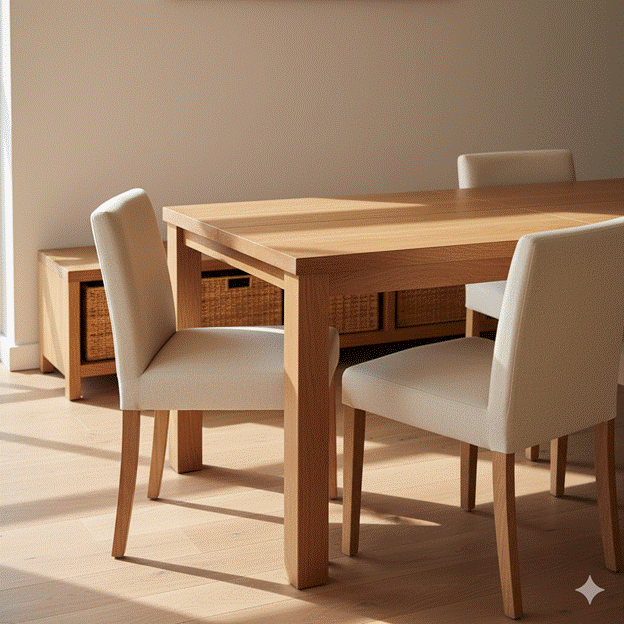
In a small apartment with children, every single piece of furniture must earn its place — and the most valuable pieces are those that earn it twice over. Multifunctional furniture is not a compromise; it is the single most transformative decision available to families navigating limited square footage.
Consider a dining table that extends for homework and contracts for a quiet breakfast. A storage ottoman that anchors the living room while swallowing toys, blankets, and board games. A sofa with a pull-out bed that transforms the living space into a guest room without surrendering floor space during the day.
The aesthetic principle here is one of deliberate restraint — fewer, better pieces that carry multiple functions with visual grace. Choose natural materials like solid oak, warm walnut, and linen upholstery that age beautifully and maintain their visual integrity through years of family life.
Styling Tip: When selecting multifunctional pieces, prioritise those with hidden storage at every opportunity. The most elegant family apartments are those where the evidence of family life can be contained at will, allowing the space to breathe between the beautiful chaos of daily living.
2. Build a Vertical Storage System Throughout
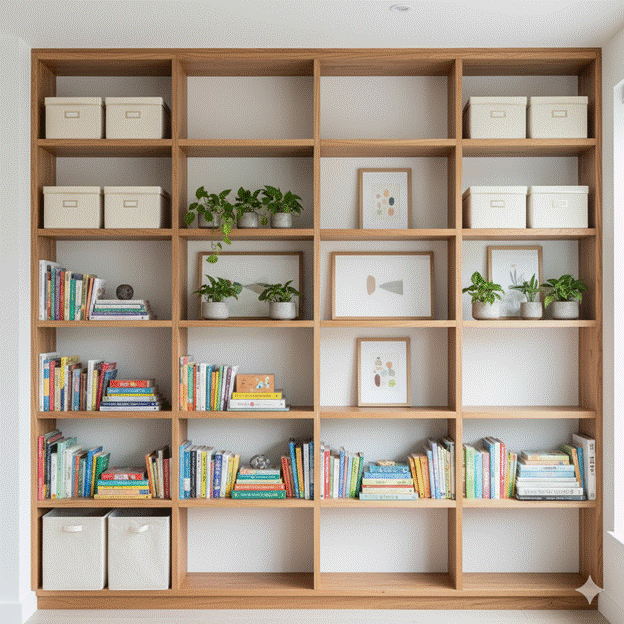
Floor space in a small apartment is the most precious commodity available. The solution is to think vertically — to treat every wall from floor to ceiling as a potential storage surface and allow the floor itself to remain as clear as possible.
Floor-to-ceiling shelving units create a dramatic vertical rhythm in any room while providing enormous storage capacity. In a children’s bedroom, this means books, toys, and clothing can be organised at accessible lower levels while less frequently used items migrate upward. In a living space, floating shelves at varying heights add architectural interest while keeping surfaces flexible.
The visual principle is cohesion — a consistent material story across all storage pieces prevents the fragmented, cluttered appearance that multiple mismatched storage solutions inevitably create. White, natural timber, or a single muted colour throughout unifies even the most storage-dense walls into something that reads as considered and calm.
Styling Tip: Install a continuous picture rail at ceiling height and hang storage baskets, pendant lights, and artwork from it — this preserves plaster walls while allowing the styling of high vertical spaces to change with the seasons without commitment.
3. Design a Dedicated Kids Zone Within Shared Spaces
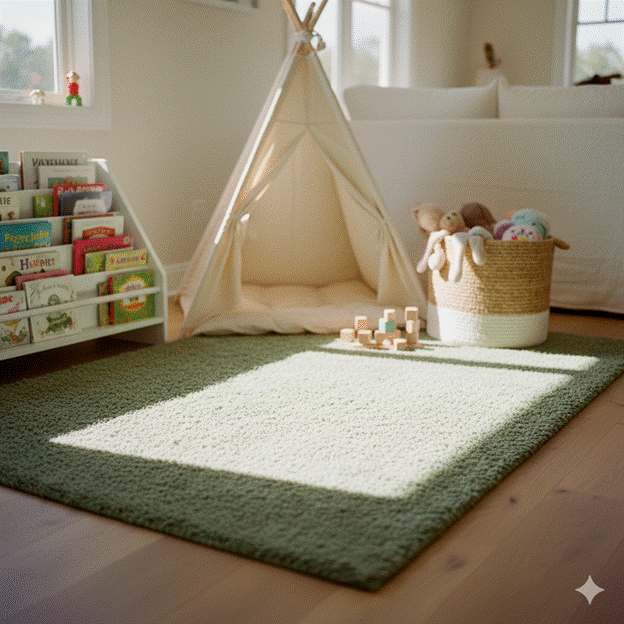
One of the most powerful strategies for maintaining visual order in a small apartment with children is the concept of the dedicated zone — a clearly defined area within a shared room that belongs to the child and has defined boundaries with the adult living space surrounding it.
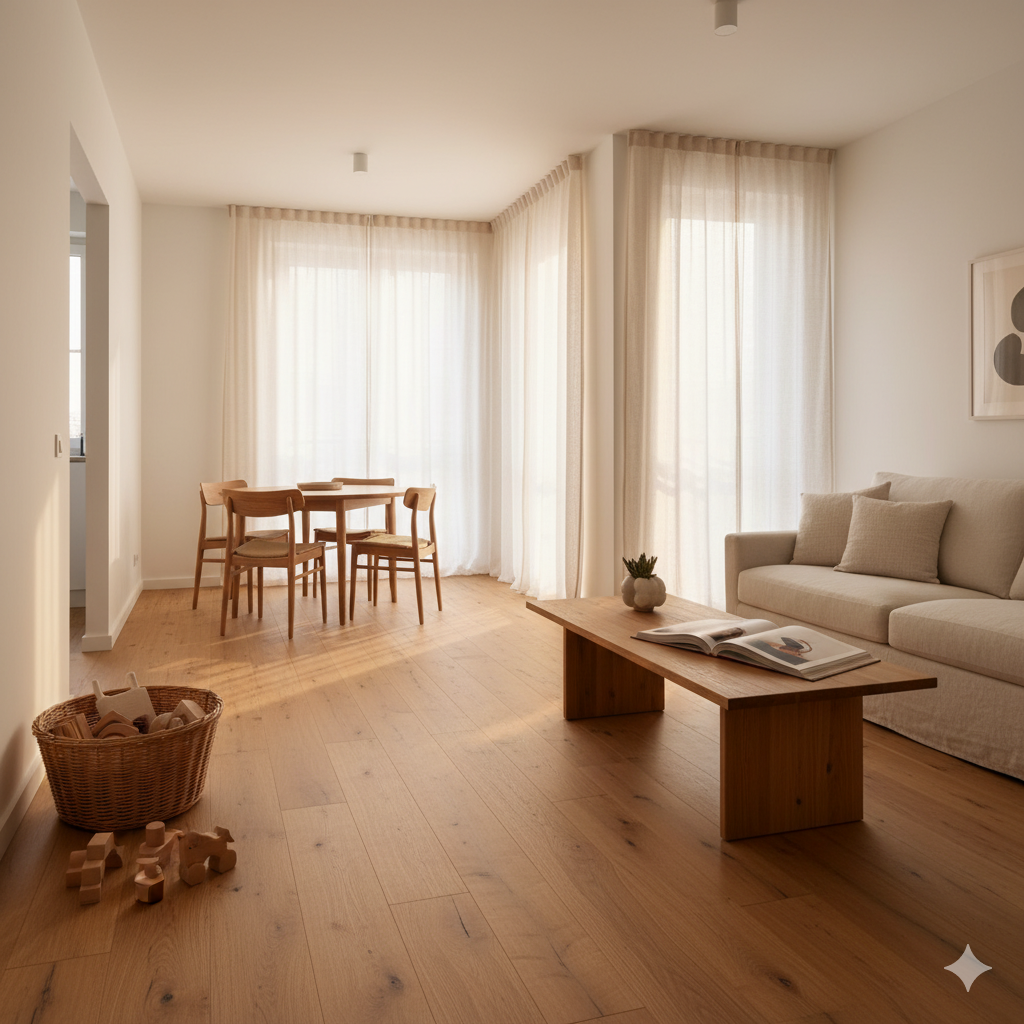
This is not about physical barriers. A children’s corner can be delineated entirely through design language: a play rug in a contrasting texture, a lower ceiling treatment created with a canopy or string lights, a distinct colour palette on a single wall. The zone communicates to everyone in the family where play lives and where it ends.
The most successful children’s zones are designed with the same visual thoughtfulness as the rest of the apartment. Natural rope baskets for toy storage, a small linen tent or teepee, a low timber shelf for books — these elements create a children’s environment that is genuinely charming rather than visually disruptive to the wider space.
Styling Tip: Choose a corner that receives good natural light for the children’s zone — it makes the space feel like a destination rather than an afterthought, and natural light is proven to support children’s focus and mood during play.
4. Use a Neutral Base Palette with Playful Accents
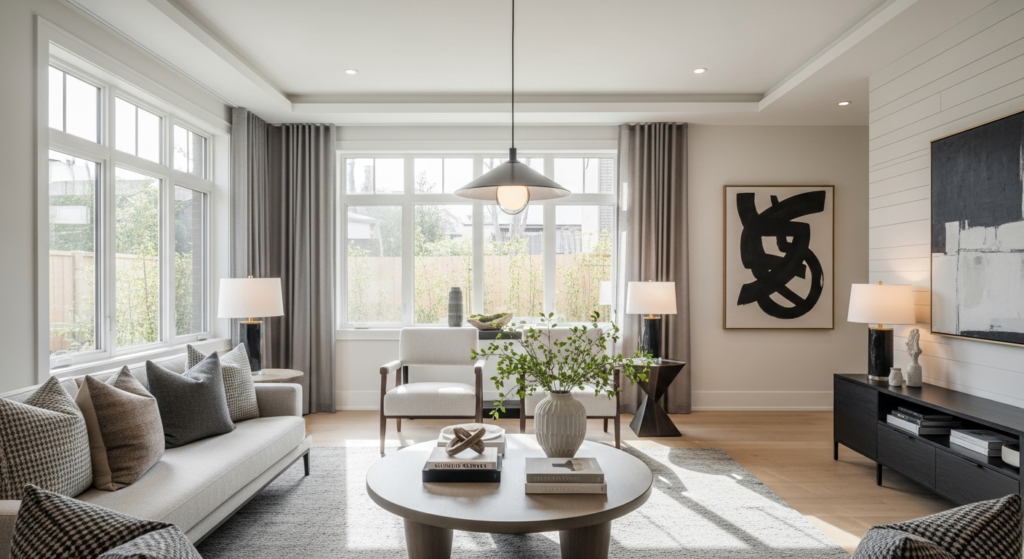
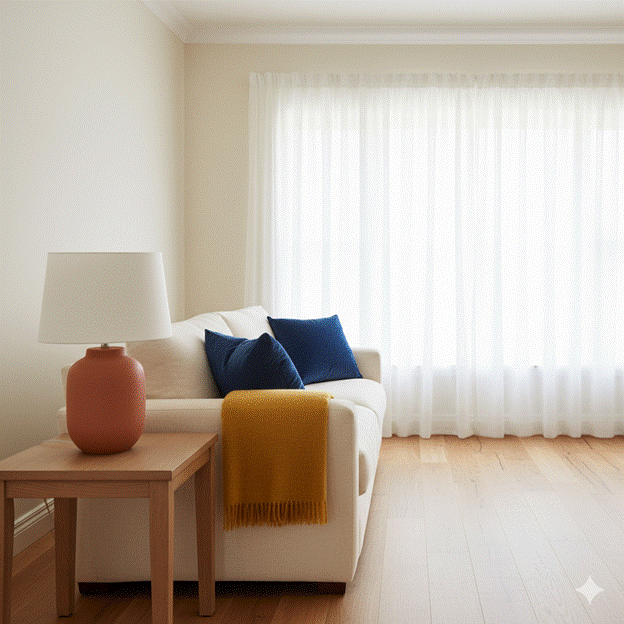
Colour is the most immediate tool available to the small apartment decorator, and its application in a family home requires particular thoughtfulness. A neutral base palette — warm whites, soft linens, pale oak tones, muted sage — creates the visual expansiveness that small spaces need while providing the flexibility to evolve as children grow and tastes change.
The playful element comes through in accents that can be updated without repainting walls or replacing furniture: a terracotta throw on the sofa, a cobalt blue lamp in the children’s corner, mustard yellow cushions on a reading bench. These elements bring life, warmth, and the unmistakable personality of a family home without visual chaos.
The discipline required is this: choose three accent colours maximum and apply them consistently throughout the apartment. A colour story that moves from room to room with coherence creates the impression of a much larger, more considered space.
Styling Tip: Use the 60-30-10 colour rule as a guide — 60% neutral base, 30% secondary tone (such as a warm grey or dusty sage), and 10% accent colour. This proportion creates visual balance in small spaces while allowing enough personality to feel genuinely lived-in rather than staged.
5. Maximise Natural Light with Thoughtful Window Treatments
Natural light is the single most effective space-expanding tool available in any home, and in a small apartment with children its preservation and amplification should be treated as a design priority above almost everything else.
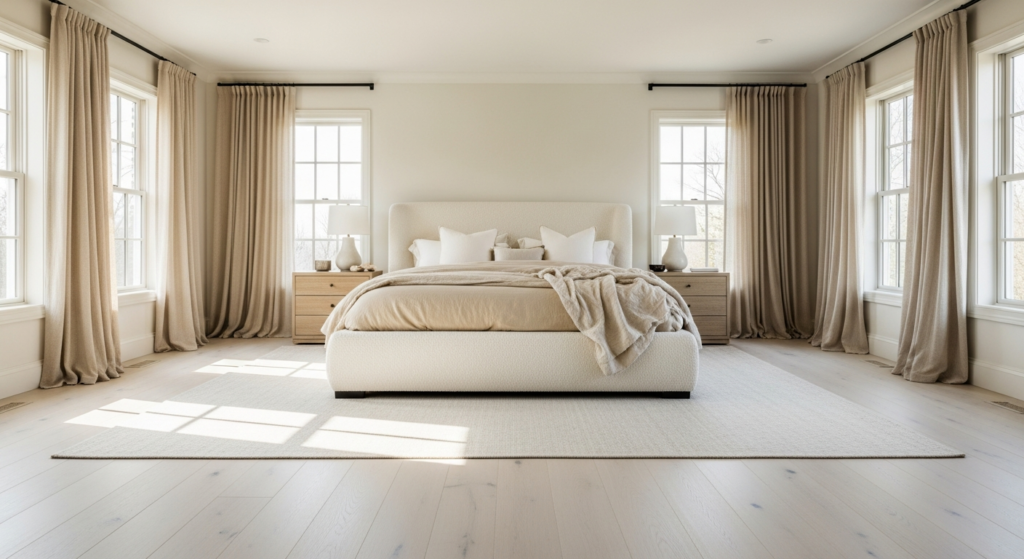
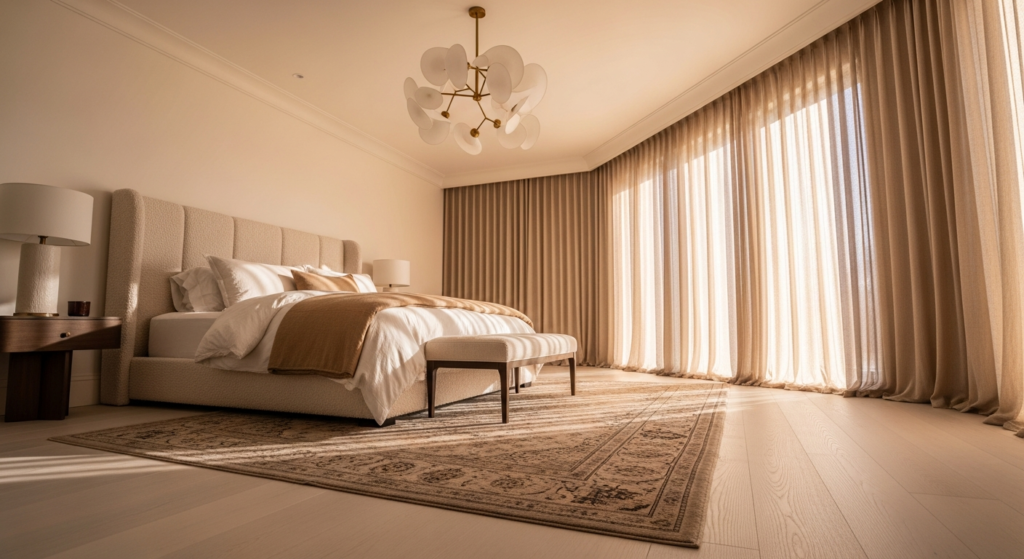
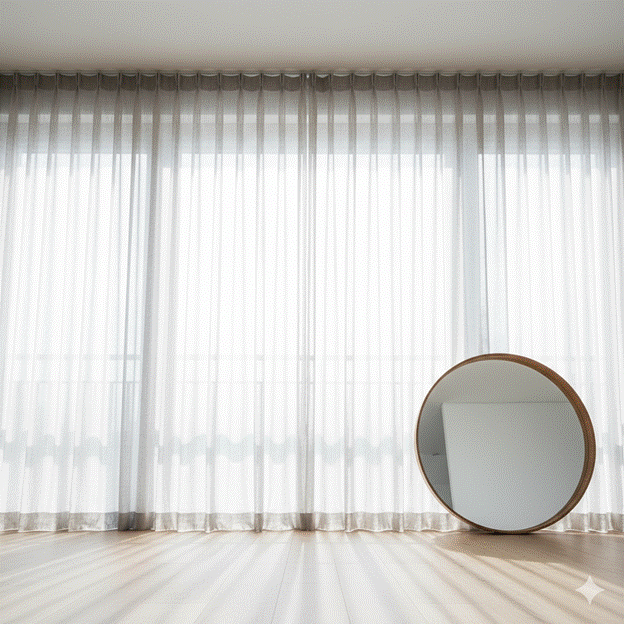
Avoid heavy curtains that pool on the floor and block light from lower windowpanes. Instead, choose sheer linen panels that filter light into a warm, diffused quality throughout the day, or Roman blinds in a natural fabric that can be raised entirely to flood the room with uninterrupted light. Hang curtain rods as close to the ceiling as possible and extend them beyond the window frame on each side — this creates the visual impression of taller, wider windows than actually exist.
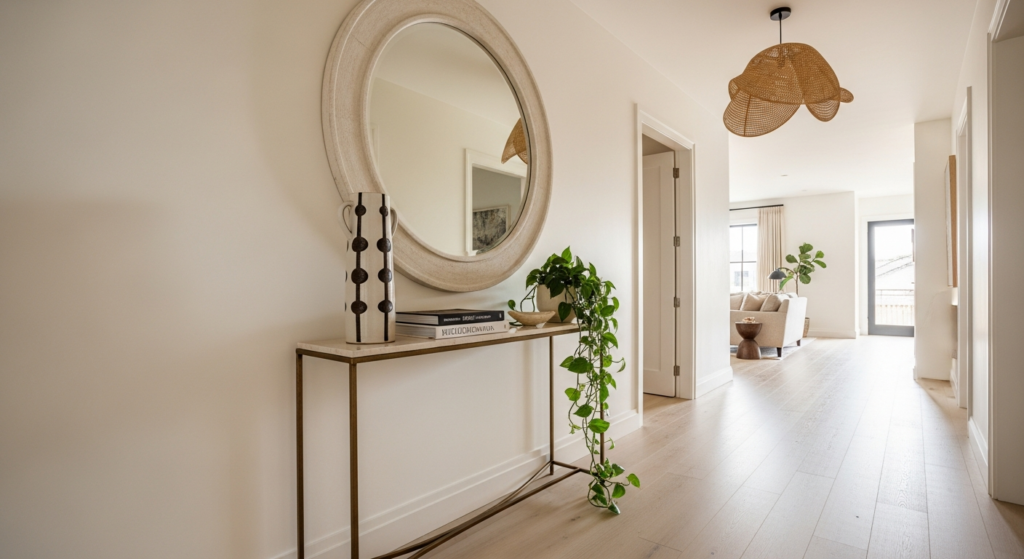
Mirrors are the natural partner to thoughtful window treatment. A large mirror positioned opposite the primary light source doubles the apparent light in a room and creates a sense of depth that genuinely transforms small spaces. Choose mirrors with slim, natural timber frames that add warmth without visual weight.
Styling Tip: A strategically placed mirror at the end of a hallway or opposite a window can make a small apartment feel as though it opens outward into another room. This is one of the oldest and most reliable tricks in interior design — and it costs remarkably little to execute.
6. Choose Space-Smart Bedroom Solutions for Kids
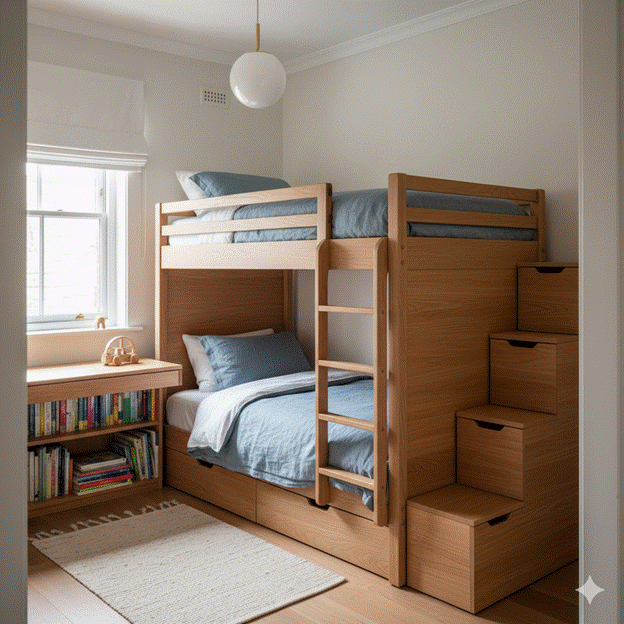
Children’s bedrooms in small apartments are where the most creative thinking in family interior design happens — and where the investment in smart spatial solutions delivers the greatest return. The bunk bed remains the quintessential small-space family solution, and its current design expressions are a world away from the utilitarian metal frames of past decades.
Contemporary bunk beds in solid timber with integrated ladder storage, under-bed drawers, and small desk surfaces built into the lower bunk structure transform a single floor area into a complete child’s world — sleeping, studying, and storage all addressed within the bed’s own footprint. For a single child, a lofted bed with a desk or reading nook beneath achieves the same spatial economy with great visual drama.
Trundle beds are another quietly brilliant solution — a day bed at normal height with a rolling second mattress stored beneath, revealed when needed for sleepovers and returned invisibly during daily life. The bed becomes two when the apartment needs it and one when it does not.
Styling Tip: If space permits, choose a bunk or loft bed that includes a privacy curtain for the lower berth. Children deeply appreciate the sense of a personal, enclosed space, and the curtain adds a cosy, den-like quality that makes the compact bedroom genuinely special rather than merely functional.
7. Create a Family Command Centre for Household Organisation
Family life generates an extraordinary volume of paper, activity schedules, permission slips, artwork, and daily administrative friction. In a small apartment, allowing this material to colonise counter surfaces and tabletops creates a sense of disorder that visual styling alone cannot overcome.
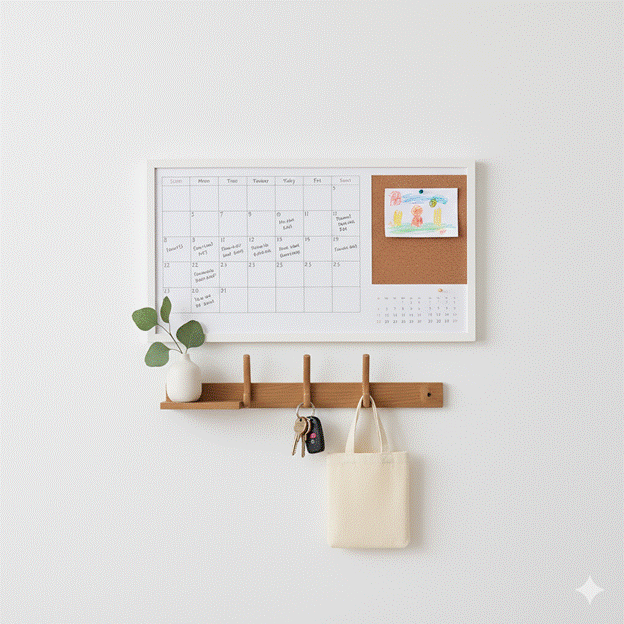
The solution is the family command centre — a dedicated wall-mounted organisation system in the kitchen or hallway that centralises all household management into a single, visually contained area. A combination of a corkboard for pinning time-sensitive items, a magnetic calendar for the month’s schedule, a small shelf for daily essentials, and labelled hooks for keys and bags creates a system that addresses the entire administrative dimension of family life in one place.
When well-designed, the command centre is not merely functional — it is an opportunity for genuine visual styling. Choose a consistent frame material, add a small succulent or single stem vase, and treat the space with the same care you would bring to any other decorative element in the apartment.
Styling Tip: Paint the command centre wall in a chalkboard paint for maximum flexibility, or use a large framed magnetic whiteboard as the centrepiece. The key is to contain everything within a defined frame — the visual boundary transforms what could feel like clutter into an organised display.
8. Invest in Flexible, Lightweight Furniture That Moves
Rigidity is the enemy of small apartment living with children. The space that works perfectly for a Tuesday evening dinner must transform efficiently for a Friday afternoon of active indoor play, and back again for a Sunday morning of reading and quiet time. The furniture that enables this transformation is furniture that moves.
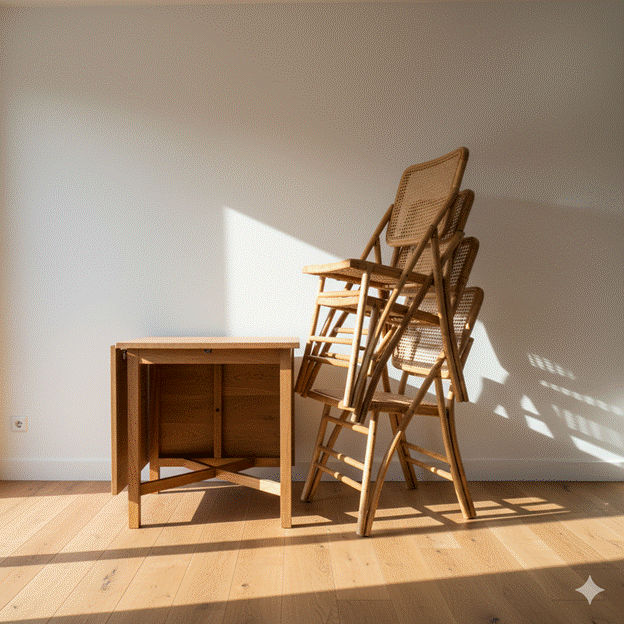
Lightweight chairs that stack easily, a folding dining table that contracts to a console against the wall, a pouf that rolls between the children’s corner and the sofa — these are the elements that give a small apartment genuine spatial flexibility. The ability to reconfigure a room in minutes rather than hours transforms the way a family inhabits their home.
Aesthetically, the key is to choose flexible furniture in materials that complement the fixed elements of the room. A rattan folding chair adds warmth and texture to a neutral interior. A timber-framed folding table maintains the natural material story of the space even when extended for family gatherings.
Styling Tip: Invest in a set of four matching lightweight chairs that can be used at the dining table, moved to the living area for additional seating during gatherings, or stacked in a cupboard entirely when the floor space is needed for play. Consistency of material and colour makes this flexibility look intentional rather than improvised.
9. Use Clever Under-Stair and Niche Storage
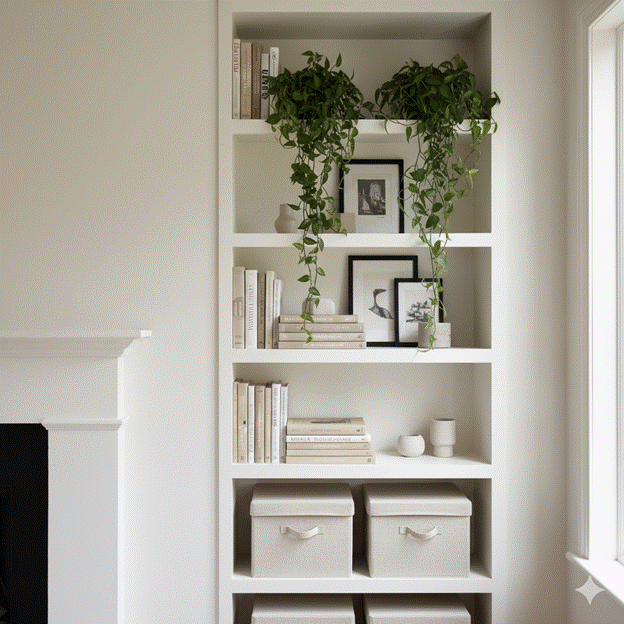
Every small apartment has unexploited spatial opportunities — the alcove beside the chimney breast, the recess beneath a staircase, the awkward corner between a door and a wall. These are not architectural inconveniences; they are storage opportunities in disguise, waiting to be recognised and designed.
Built-in shelving within an alcove transforms dead wall space into a library, a display surface, or a toy organisation system. Fitted cupboards under stairs convert an otherwise wasted volume into a coat room, a cleaning cupboard, or a children’s reading nook with a cushioned bench and a shelf of favourite books.
The design principle is integration — built-in solutions that are painted the same colour as the surrounding walls disappear visually while providing substantial storage. The room looks larger, calmer, and more coherent because the storage has been absorbed into the architecture rather than applied to its surface.
Styling Tip: When designing built-in storage, include at least one section with open shelving for display and a section with concealed doors or baskets for less visually appealing but frequently accessed items. This ratio of display to concealment keeps the aesthetic clean while maintaining genuine practicality.
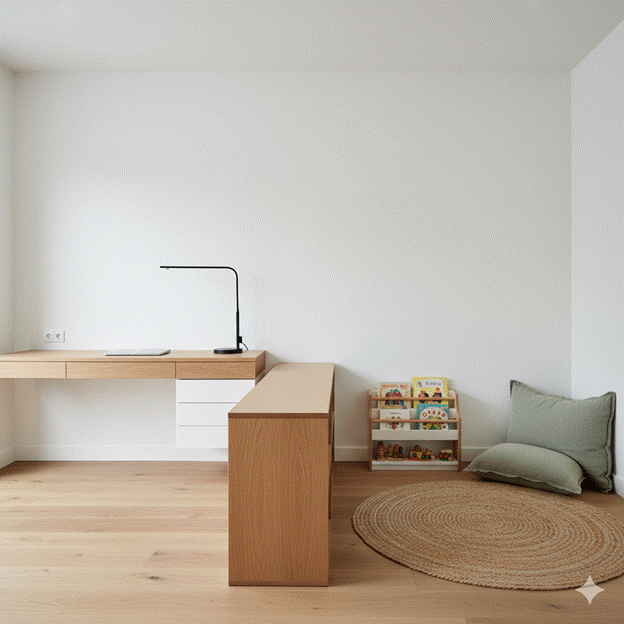
10. Design a Dual-Purpose Home Office and Play Area
The modern family apartment must accommodate remote work alongside the full demands of family life — and in a small space, these two worlds frequently share the same square footage. The dual-purpose home office and play area is one of the most sophisticated design challenges in contemporary family living, and one of the most satisfying to resolve.
The key is physical separation of zones within the same room — a desk positioned to face a wall or window, creating a visual focus for work, with the children’s area naturally behind or beside it. The desk height and chair should clearly signal adult working territory, while the rug, low shelving, and play materials of the children’s area signal something altogether different.
During work hours, a simple room divider, a curtain on a ceiling-mounted track, or even a tall bookshelf positioned as a partial partition can create enough visual and acoustic separation to make both zones function effectively. In the evenings, the partition folds away and the room becomes a unified family space again.
Styling Tip: Choose a desk with substantial built-in storage — drawers, cable management, and a hutch above — so that work materials can be entirely contained within the desk’s own footprint. When the working day ends, close the drawers, fold the laptop away, and the desk reads simply as a piece of furniture rather than an office intrusion.
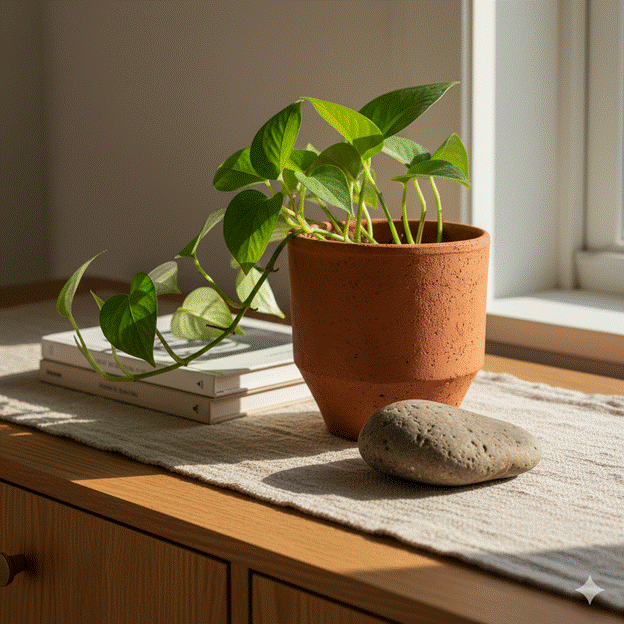
11. Bring Nature In with Indoor Plants and Natural Materials
The presence of living plants and natural materials in a small apartment with children creates something that no amount of clever storage or flexible furniture can replicate: a sense of life, warmth, and connection to the natural world that makes a compact space feel genuinely nurturing rather than merely efficiently organised.
A trailing pothos on a high shelf, a fiddle-leaf fig in a ceramic pot beside a window, a cluster of small succulents on a kitchen windowsill — these elements introduce organic colour, texture, and movement into an interior. They soften hard architectural lines and create a sense of abundance that the most minimal apartment needs.
Natural materials tell the same story through different means. A jute rug grounds a living space with warmth and texture. Linen cushion covers breathe with the seasons. A timber fruit bowl on the kitchen counter adds an honest, unpretentious beauty to the most functional of surfaces. Together, these elements create an interior that feels cared for and considered rather than merely furnished.
Styling Tip: Choose plants that genuinely thrive in the light conditions of your specific apartment rather than those that merely look beautiful in design photographs. A thriving, vigorous plant is always more beautiful than a struggling one, regardless of species. Pothos, monstera, ZZ plant, and snake plant are among the most resilient options for varied light conditions.
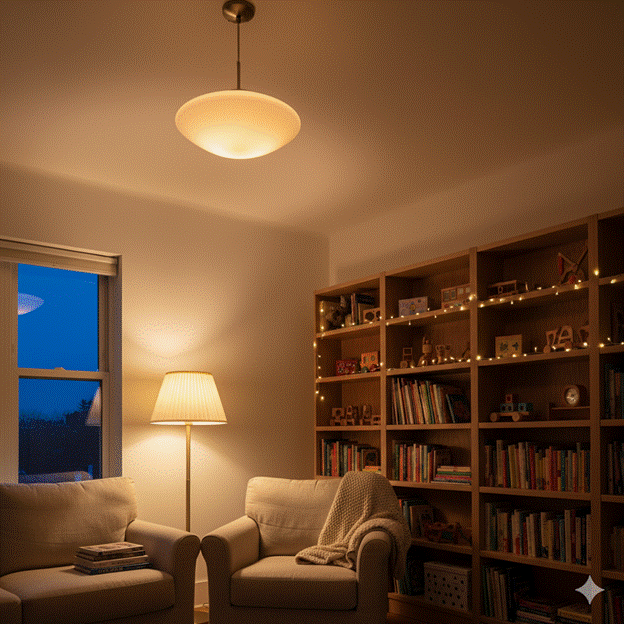
12. Layer Lighting for Atmosphere and Function
Lighting is the most underestimated element in small apartment design, and in a family home its thoughtful layering has the power to transform the emotional quality of a space as dramatically as any structural change. A single overhead light fitting — however beautiful — cannot create the warmth, depth, and atmospheric flexibility that family life requires across the course of a single day.
The principle of layered lighting involves three distinct levels: ambient light (the overall illumination of the room), task lighting (focused light for specific activities — reading, cooking, homework), and accent lighting (the warm, low-level light that creates atmosphere in the evenings). A small apartment designed with all three layers can feel like a completely different space at different times of day.
For a family apartment, consider warm-toned LED bulbs throughout (2700–3000K), a dimmer switch on the primary overhead fitting, a floor lamp beside the reading chair, clip-on task lights at the children’s desk, and a string of warm fairy lights in the children’s zone for evening calm. This simple configuration creates enormous atmospheric range within a modest budget.
Styling Tip: Install dimmer switches as the single most cost-effective lighting upgrade available. The ability to reduce overhead light to 30% in the evening transforms the atmosphere of any room and signals to children’s nervous systems that the day is winding toward sleep — a practical and aesthetic benefit simultaneously.
Conclusion
A small apartment with children is not a design limitation — it is a design brief. The constraints of limited square footage, combined with the genuine and beautiful demands of family life, create the conditions for some of the most creative and considered interior design that exists.
The 12 ideas explored in this guide share a common philosophy: that thoughtful design is always more powerful than expensive design, and that the most liveable family homes are those where aesthetic care and practical intelligence have been applied in equal measure.
Begin with the foundations — multifunctional furniture, vertical storage, a coherent colour palette — and build outward from there. Layer in natural materials, thoughtful lighting, and flexible zones as the budget and opportunity allow. And approach the whole project with the patience and curiosity that the best interior design has always required.
The small apartment with children that you dream of is achievable. It simply requires seeing your space not as it is, but as it could become.
Frequently Asked Questions
Q1. How do you make a small apartment feel bigger when you have kids?
The most effective strategies for making a small apartment feel larger with children are: maintaining a neutral, consistent colour palette throughout; maximising natural light with sheer window treatments and mirrors; keeping floors as clear as possible through vertical and built-in storage; and choosing furniture scaled appropriately to the room rather than oversized pieces that overwhelm the space.
Q2. What is the best flooring for a small apartment with young children?
Engineered hardwood or high-quality vinyl plank flooring are the most practical and aesthetically pleasing options for family apartments. Both are durable, easy to clean, warm underfoot with the addition of rugs, and available in natural timber tones that work beautifully with any colour palette. Layer a washable cotton or flatweave rug in the play zone for additional softness and acoustic dampening.
Q3. How do you create storage in a small apartment with no built-ins?
Freestanding floor-to-ceiling shelving units, under-bed storage drawers, storage ottomans, wall-mounted floating shelves, and over-door organisers are the most effective storage solutions in apartments without built-in storage. The key is consistency of material and colour across all freestanding storage to prevent the fragmented appearance that multiple mismatched pieces create.
Q4. What colours work best in a small apartment with children?
Warm whites, soft linens, pale sage, and muted terracotta are the most successful base colours for small family apartments — they maximise the perception of space while creating a genuinely warm atmosphere. Introduce children’s personality through accents — a cobalt blue cushion, a mustard yellow lamp, a coral art print — that can evolve as children grow without requiring a full repaint.
Q5. How do you keep a small apartment tidy with children?
The single most effective approach is designing storage systems that children can actually use independently — low, open shelving for toys, labelled baskets at accessible heights, a clearly defined place for everything. The five-minute tidy rule — a short, daily reset of all rooms before bedtime — is more effective than occasional deep tidying sessions and helps children develop ownership of their shared space.