Introduction
Minimalism is one of the most misunderstood philosophies in contemporary interior design. Too often it is conflated with emptiness — with cold white rooms devoid of warmth, personality, or the visible evidence of human habitation. This interpretation is not only inaccurate; it misses the profound beauty that genuine minimalist living room design is capable of achieving.
A truly minimalist living room is not a room with nothing in it. It is a room with exactly the right things in it — chosen with precision, arranged with intention, and allowed to breathe within a space that honours their presence with generous scale and quiet, considered light. It is a room in which every object earns its place and every surface communicates a deliberate choice.
The best minimalist living rooms are among the most beautiful and the most genuinely liveable interior spaces in the world. They offer their inhabitants something increasingly rare in the modern home: visual calm. The feeling of entering a well-designed minimalist living room — the immediate sense of settled ease, of visual noise receding, of space and light taking over — is one of interior design’s most compelling and most deeply satisfying experiences.
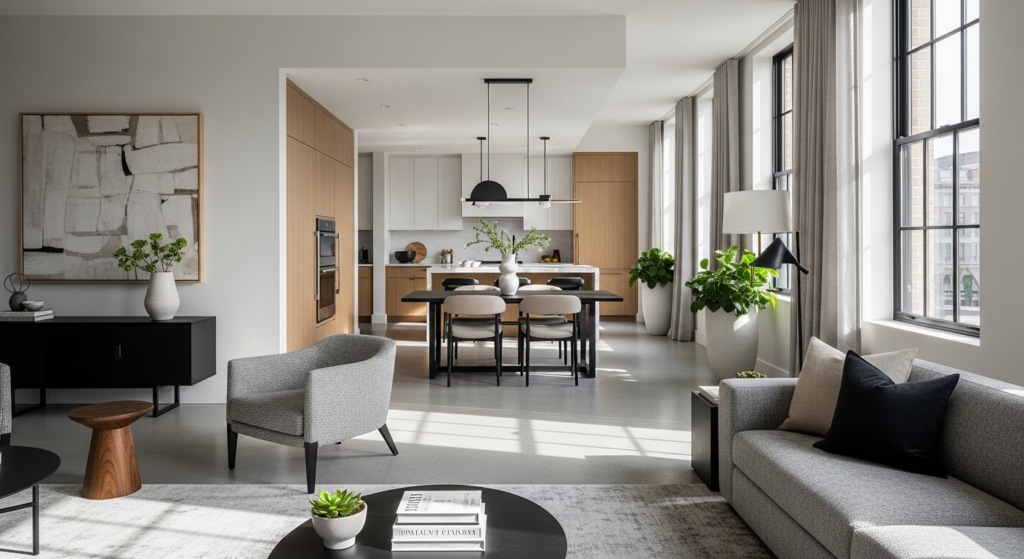
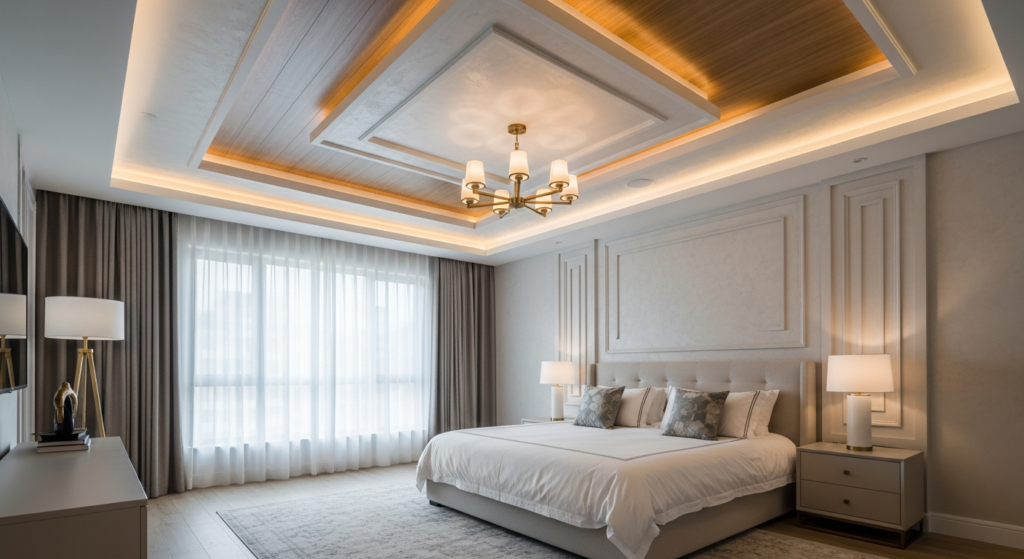
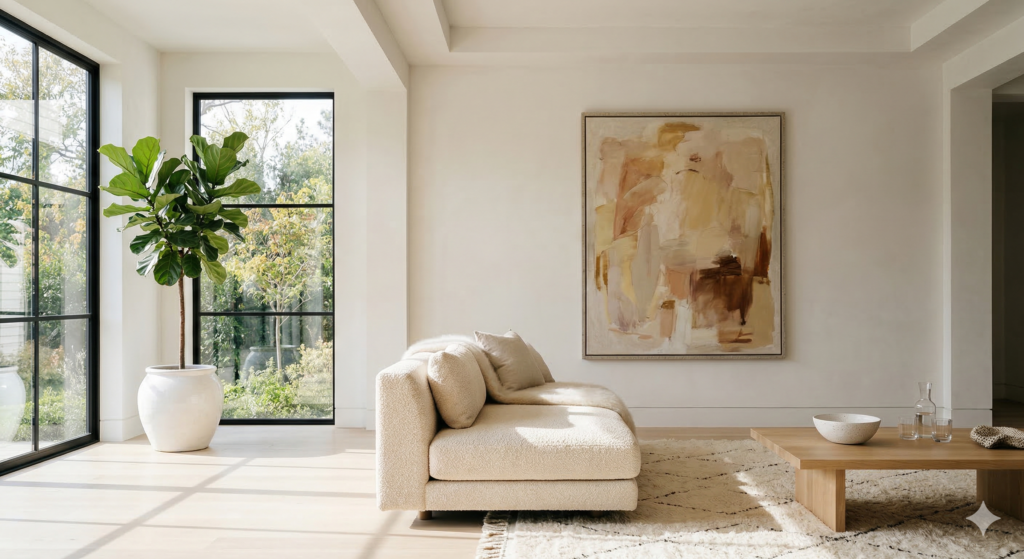
Here are the top 14 minimalist living room ideas for stunning home inspiration — each one a fully considered design blueprint for creating a space of genuine beauty, intelligent function, and lasting calm.
1. Embrace a Warm Neutral Colour Palette
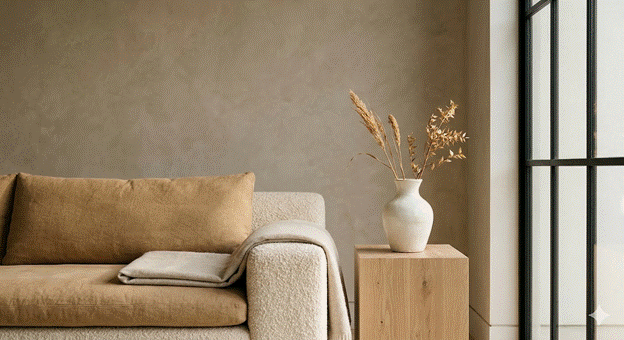
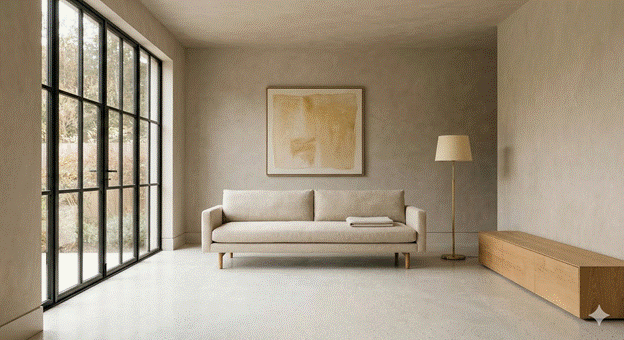
The colour palette is the first and most foundational decision of any minimalist living room — and the most important insight to absorb before choosing is that minimalism is not synonymous with white. The most beautiful minimalist living rooms are built on warm neutral palettes: the rich, organic tones of natural materials that carry genuine warmth, depth, and sensory comfort into a restrained colour scheme.
Warm stone, pale sand, aged linen, soft clay, warm greige, and barely-there blush are the most versatile and most enduringly beautiful minimalist living room colour foundations. These tones are simultaneously calming and warm, minimal and inviting — they create the visual quiet that minimalism requires without the clinical coldness that a purely cool palette produces.
Styling Tip: Carry your chosen neutral consistently across walls, ceiling, and large furniture to create a seamless, enveloping spatial quality. The eye finds no interruption and is drawn instead to the quality of light and the texture of surfaces — which are the true subjects of a minimalist interior. Introduce depth through tonal variation within the palette rather than through contrast: a slightly deeper cushion against a slightly lighter sofa against a slightly lighter wall creates a layered, three-dimensional result within a single colour family.
2. Choose Low-Profile, Clean-Lined Furniture
Furniture is the primary structural element of any living room, and in a minimalist space it carries a disproportionate design responsibility. Every piece must be chosen with exceptional care — not only for its individual aesthetic quality but for how it relates to every other piece in the room and to the architecture of the space itself. In a minimalist living room, furniture that is too heavy, too tall, or too ornamented disrupts the visual calm that the design depends upon.
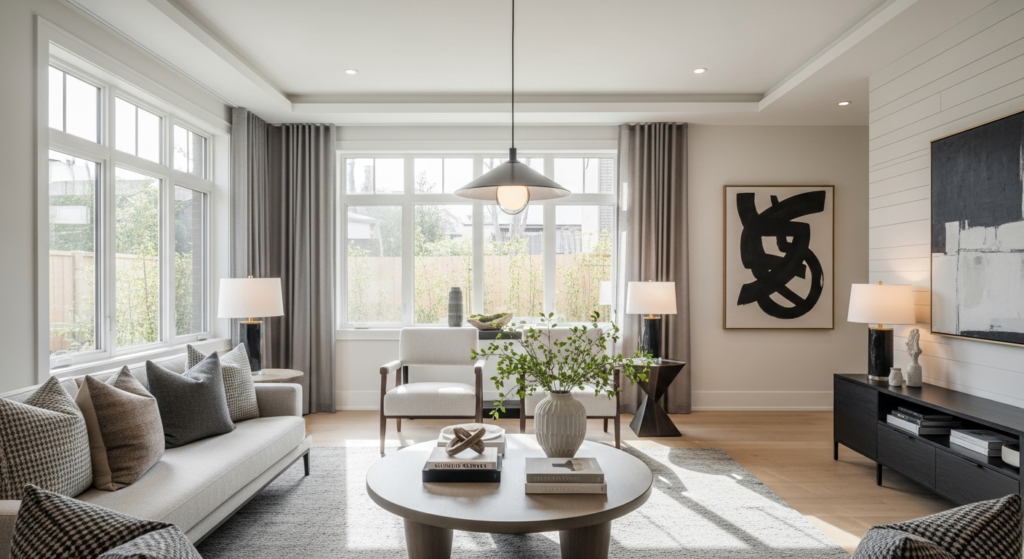
Low-profile furniture — sofas, coffee tables, side tables, and shelving units that sit closer to the floor and maintain a clean, unobstructed sightline across the room — is the defining furniture choice of great minimalist living rooms. It creates the impression of greater ceiling height, allows light to travel freely across the floor, and produces a visual openness that higher, heavier furniture inevitably forecloses.
Styling Tip: Choose a sofa with visible legs rather than a base that extends to the floor — the gap between the sofa base and the floor creates a critical visual breathing space that makes the entire room feel lighter and more open. A platform sofa in a premium linen, boucle, or velvet fabric in a warm neutral is the most sophisticated and most enduringly beautiful minimalist living room centrepiece available. Resist the temptation to add too many occasional chairs — two is usually the maximum a minimalist living room can accommodate without beginning to feel crowded.
3. Invest in One Statement Art Piece
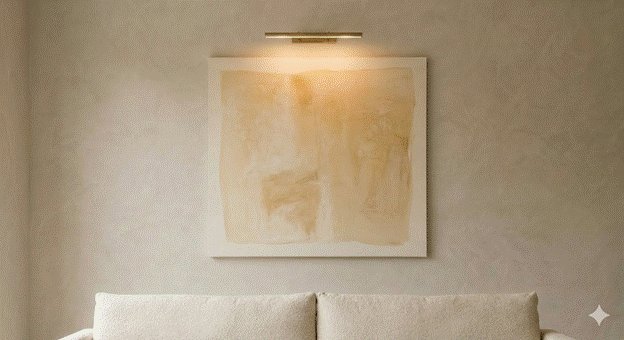
Art is the element in a minimalist living room that most powerfully communicates personality, creates emotional depth, and provides the visual focus that a room of restrained objects requires. In a space where every other element has been edited to its most essential form, a single significant artwork carries an extraordinary weight of expressive responsibility — and when chosen well, it fulfils that responsibility with magnificent completeness.
A large-scale abstract work in warm earth tones — ochre, sienna, raw umber, pale blush — on a primary wall creates a focal point of considerable impact that the surrounding minimalism amplifies rather than diminishes. The restraint of everything around it allows the artwork to be seen with complete clarity, without competition or visual noise, which is how great art deserves to be experienced.
Styling Tip: Size the artwork generously — in a minimalist room, an artwork that is too small reads as timid and loses much of its intended impact. A canvas or framed work that spans at least two-thirds of the wall width it occupies creates a statement of appropriate visual authority. Hang it at eye level, centred on the wall’s midpoint or centred above the sofa, and leave the surrounding wall completely clear of any additional objects. A picture light above the canvas in a warm brass finish adds a layer of considered, intimate illumination that activates the artwork beautifully in evening light.
4. Use Natural Light as a Design Element
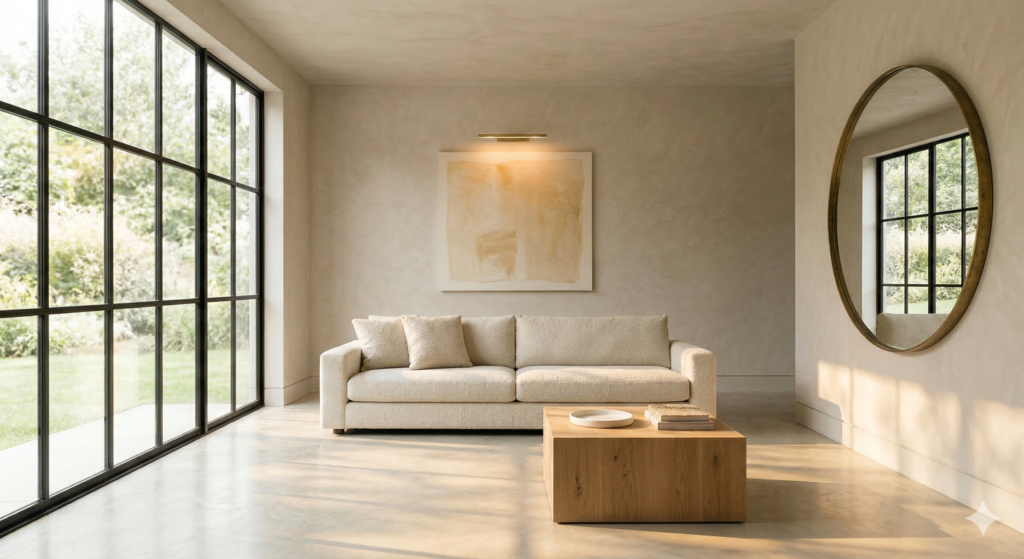
Natural light is the most powerful, most free, and most consistently underestimated design element available to any interior space — and in a minimalist living room, where surfaces are clean, furniture is restrained, and colour is quiet, the quality and behaviour of natural light becomes the room’s primary aesthetic experience. A minimalist living room that captures, distributes, and honours its natural light is a room of extraordinary beauty at every hour of the day.
The first priority is maximising the available light: keep window treatments minimal — sheer linen panels, simple roller blinds, or no treatment at all where privacy allows — and position furniture to allow light to travel as freely as possible across the floor and up the walls. The second priority is understanding the quality of the light: the warm amber of morning and evening light, the clear blue-white of midday, the long golden shadows of late afternoon are all equally beautiful and each deserves to be designed for deliberately.
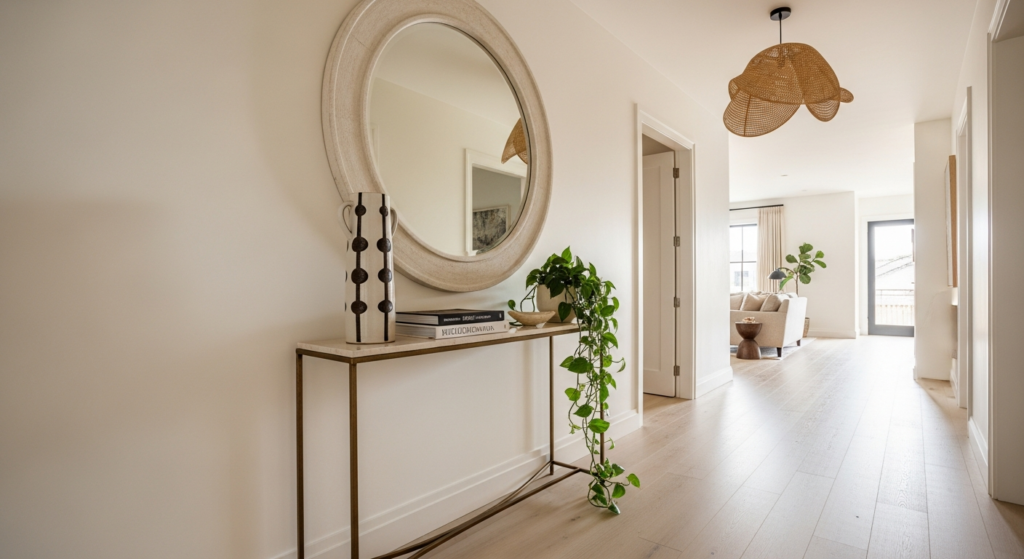
Styling Tip: A large, aged brass or raw oak framed mirror positioned on the wall perpendicular to the primary window doubles the room’s natural light by reflecting it back into the space and creates the compelling impression of an additional window. In a minimalist living room where every object is seen with maximum clarity, a beautiful mirror serves simultaneously as a spatial amplifier, a light enhancer, and a genuinely composed decorative element — three design functions from a single, considered purchase.
5. Layer Textures Without Adding Clutter
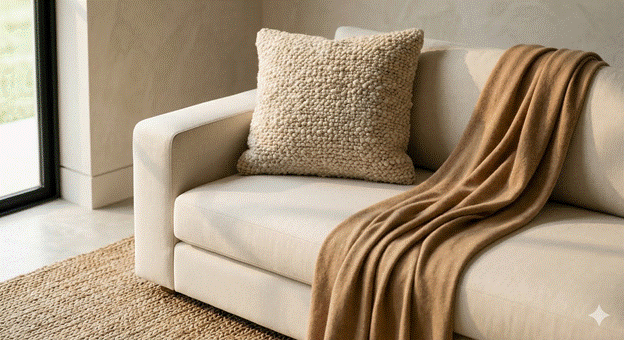
Texture is the minimalist interior designer’s most sophisticated and most essential tool — the quality that introduces warmth, sensory richness, and visual depth into a space that colour and pattern have deliberately vacated. In a minimalist living room built on a warm neutral palette, texture is not a secondary consideration but the primary source of visual interest and material beauty.
The layering of different textures within a single colour family creates a result of remarkable richness from apparently limited means. A smooth linen sofa against a chunky boucle cushion against a woven jute rug against a smooth polished plaster wall against a rough-sawn oak shelf — each surface at a different point on the textural spectrum, all within the same tonal palette, creates a room that rewards prolonged, close attention with continuously revealed material beauty.
Styling Tip: Build your minimalist living room texture palette across five distinct surface qualities: smooth and reflective (a polished plaster wall, a lacquered side table), matte and soft (a linen sofa, a cotton throw), woven and open (a jute rug, a rattan occasional chair), rough and organic (a raw timber shelf, an unglazed ceramic vessel), and plush and dense (a boucle cushion, a sheepskin throw). Moving through these five textural registers within a single neutral palette creates a room of extraordinary sensory warmth that feels genuinely, deeply comfortable rather than merely visually spare.
6. Edit Your Objects Ruthlessly
The discipline of editing — the willingness to remove, conceal, or donate every object that does not actively contribute to the room’s beauty and function — is perhaps the most demanding and most transformative practice in minimalist living room design. It is also the one that most reliably produces the greatest visible improvement for the least financial investment. A room emptied of its visual noise is simply a different, better room than the same room cluttered.
The editing process has two phases. The first is structural: removing everything that does not belong in the living room and finding it a more appropriate home or releasing it entirely. The second is curatorial: evaluating what remains and deciding which objects are beautiful and meaningful enough to be permanently displayed and which should be stored within closed cabinetry or removed from the room.
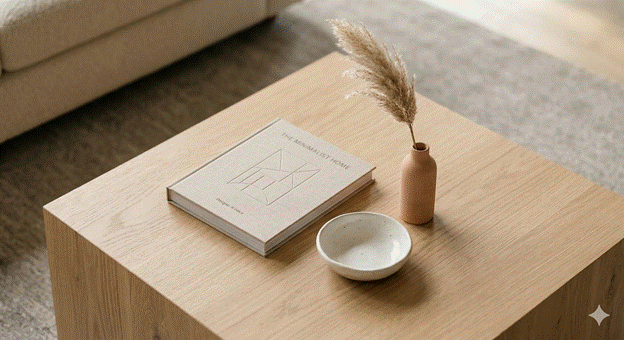
Styling Tip: Apply the three-object rule to every horizontal surface in the minimalist living room — no surface should hold more than three objects, and those three objects should vary in height, material, and visual weight to create a considered, asymmetrical composition. The coffee table holds one design book, one small ceramic vessel, and one candle. The side table holds one lamp and one small object at its base. The shelf holds three objects with deliberate negative space between each. This rule, maintained consistently, is the single most effective tool for sustaining the visual calm of a minimalist living room over time.
7. Incorporate a Statement Rug
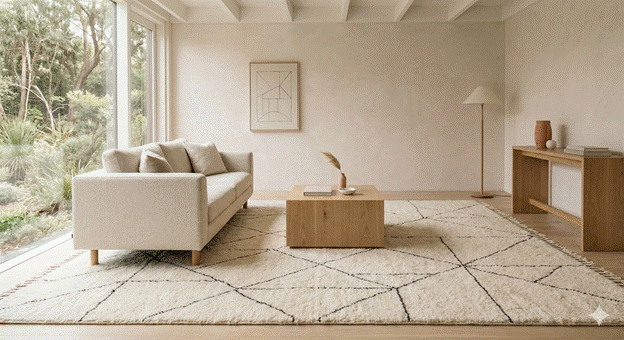
A rug in a minimalist living room performs a function of extraordinary importance: it defines the living zone, anchors the furniture arrangement, introduces warmth and texture at the room’s most prominent horizontal surface, and provides the single most significant opportunity for material expression within the restrained overall palette. The rug choice in a minimalist space deserves exceptional care.
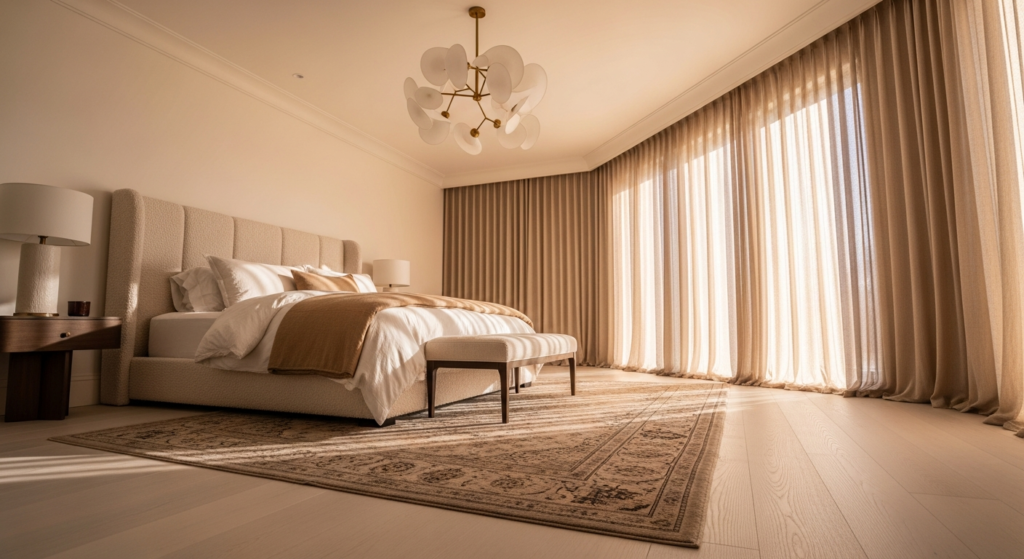
The most beautiful rugs for minimalist living rooms are those whose design language — their pattern, colour, and construction — is consistent with the room’s overarching aesthetic principles: restrained, warm, textural, and natural. A large-format Moroccan Beni Ourain in natural undyed wool, a handwoven flatweave in warm earth tones, a shaggy pile rug in a single warm neutral, or a contemporary abstract rug in muted ochre and sand are among the most compelling and most enduringly beautiful choices for a minimalist living room.
Styling Tip: Size the rug generously — the most common rug mistake in any living room, and particularly in a minimalist one, is choosing a rug that is too small for the furniture arrangement it serves. All legs of the primary seating arrangement should sit on or at the edge of the rug — a rug that is too small creates a floating, disconnected quality that undermines both the spatial definition and the visual warmth that the rug is placed to create. In a minimalist living room, the rug should be the room’s largest single textural element.
8. Design with Intentional Negative Space
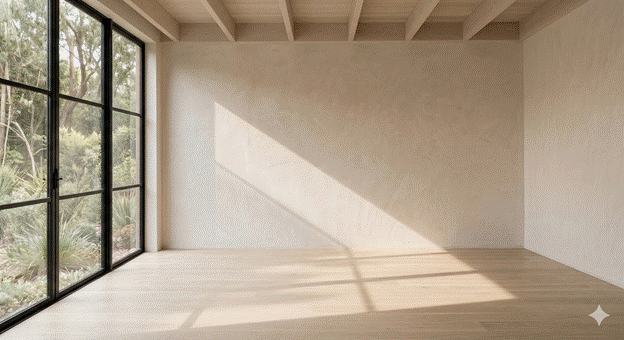
Negative space — the deliberately maintained empty areas of a room — is not the absence of design but an active and essential design element in any minimalist living room. It is the visual breathing room that allows each object to be seen fully, that creates the sense of spatial generosity, and that produces the distinctive quality of settled calm that great minimalist interiors consistently achieve. A room in which every space is occupied feels restless; a room in which space is deliberately preserved feels composed and at ease.
Negative space operates at every scale in a minimalist living room: the gap between the sofa leg and the floor, the clear wall area surrounding a single artwork, the empty counter between two styled objects, the bare corner that is simply a beautifully lit corner. Each of these preserved spaces contributes to the room’s overall quality of visual quiet.
Styling Tip: Identify the three largest clear surfaces in your living room — typically a section of wall, a large area of floor, and a principal horizontal surface — and commit to keeping them clear permanently. These three preserved negative spaces will anchor the room’s visual calm no matter what else changes within it. When the temptation to fill them arises — and it will — return to the experience of the room at its most uncluttered and consider whether the proposed addition genuinely improves upon what already exists. More often than not, the empty space is already the most beautiful thing in the room.
9. Select Minimal Window Treatments
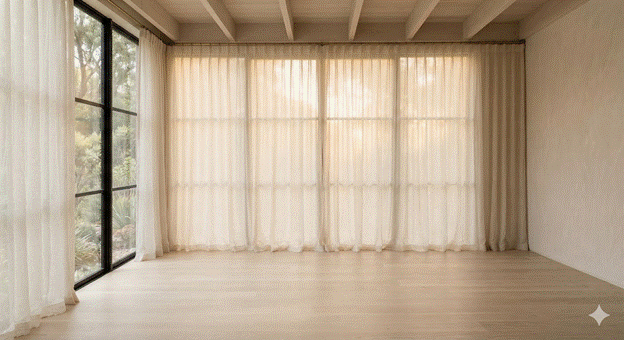
Window treatments in a minimalist living room should do one of two things: disappear entirely, allowing the architecture of the window and the quality of the natural light to exist without interruption, or add a single layer of quiet, beautiful texture that softens the window’s geometry without competing with the view or the light. Everything between these two poles — elaborate curtain systems, complex valances, heavily patterned fabrics — is incompatible with the minimalist aesthetic.
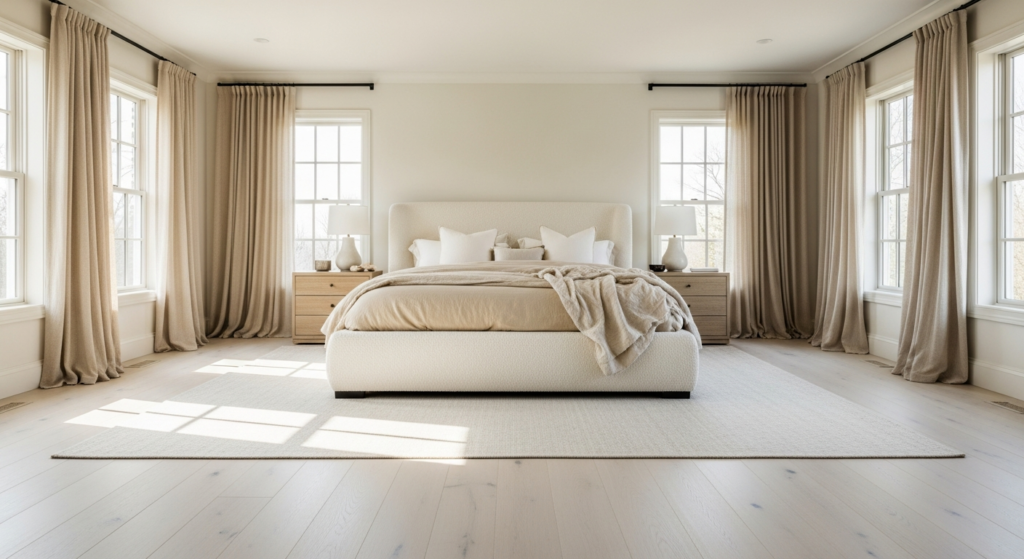
Sheer linen panels in an undyed or warm ivory tone are the most universally beautiful window treatment for a minimalist living room. They allow light to filter through with a soft, diffused quality that is deeply atmospheric at every time of day, provide a degree of daytime privacy without blocking light, and add a layer of fabric texture that contributes to the room’s overall material warmth without visual complexity.
Styling Tip: Hang curtain panels from a rod positioned close to the ceiling and extend the rod beyond the window frame on each side — this creates the impression of a window that is considerably larger and taller than its actual dimensions, adding perceived volume and grandeur to the room. Choose a rod in a warm metal finish — aged brass, matte gold, or brushed bronze — that coordinates with the room’s other metal accents. Use a single panel per window side in a full, generous width, and allow the panels to puddle very slightly on the floor for a quietly luxurious finish.
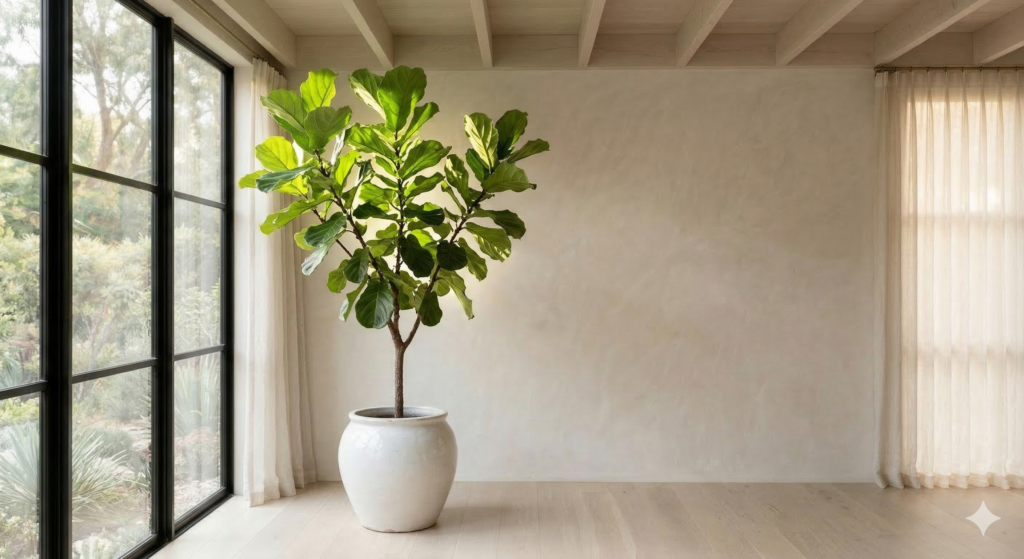
10. Introduce a Single Plant or Sculptural Botanical
A single, well-chosen plant is one of the most powerful additions available to a minimalist living room — an introduction of living colour, organic form, and natural vitality that does more for the atmosphere of the space than a dozen decorative objects could achieve collectively. The organic irregularity of a beautiful plant provides the perfect counterpoint to the clean lines and geometric precision of a well-designed minimalist room, creating a tension between the natural and the architectural that is deeply appealing.
In a minimalist context, the plant should be treated as a sculptural element: chosen for the quality of its form as much as the beauty of its foliage, and positioned with the same consideration given to any piece of art or furniture in the room. A tall Fiddle Leaf Fig beside the window, a large Monstera deliciosa in a beautifully chosen ceramic pot beside the sofa, or a cascading Pothos trailing from a high shelf creates a living focal point of genuine and ever-changing beauty.
Styling Tip: The vessel matters as much as the plant itself in a minimalist living room. Choose a planter that functions as a design object independent of its contents — a large, hand-thrown ceramic in a warm white or earthy terracotta, a smooth concrete cylinder in pale grey, or a woven basket planter in natural seagrass. The quality and considered design of the vessel communicates that the plant has been given the same decorative attention as every other object in the room, elevating it from garden centre purchase to genuine room-defining element.
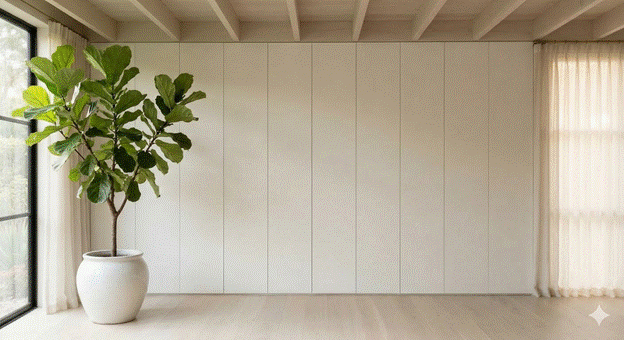
11. Optimise Storage to Maintain Cleanliness
Effective storage is the invisible infrastructure of a beautiful minimalist living room — the practical foundation that makes the sustained aesthetic achievement of the space possible on a daily basis. A minimalist living room that lacks adequate concealed storage cannot sustain its visual calm over time, because the objects of daily life have nowhere to go except the surfaces and floor that the design intends to keep clear.
Built-in cabinetry with clean, handle-free door fronts that blend seamlessly into the wall behind them is the most elegant storage solution for a minimalist living room. Floating media units with closed storage, built-in bookshelves with alternating open and closed sections, and concealed side table storage all provide the practical capacity the room requires without introducing the visual complexity that would undermine its aesthetic integrity.
Styling Tip: Commission or purchase cabinetry in the same tone and finish as the walls wherever possible — this creates the seamless, architectural quality of built-in storage that disappears into the room rather than sitting within it as a piece of furniture. Handle-free push-to-open mechanisms eliminate the need for hardware entirely, maintaining the clean, unbroken surface of the cabinetry door and contributing to the room’s overall quality of visual quiet. A single long, low media unit that spans the full width of the wall creates a strong horizontal line of considerable elegance that grounds the room while providing generous concealed storage.
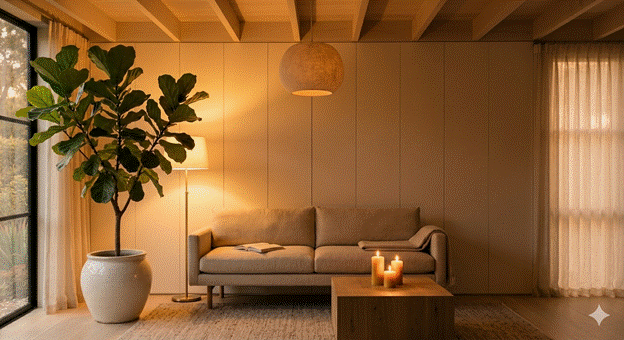
12. Layer Lighting Across Multiple Sources
Lighting design is the most technically complex and most atmospherically transformative element of any living room — and in a minimalist space, where surfaces are clean, colour is restrained, and objects are few, the quality and character of the light becomes one of the room’s most prominent and most defining aesthetic experiences. A minimalist living room lit badly is a cold, uncomfortable space; the same room lit well is a place of extraordinary beauty.
The lighting scheme of a well-designed minimalist living room operates across three distinct layers: ambient light that fills the space without harshness (a statement ceiling fixture, wall sconces, or cove lighting), task light that provides focused illumination where it is needed (a floor lamp beside the reading chair, a table lamp on the side table), and accent light that creates warmth and atmosphere at lower levels (the candle on the coffee table, the LED strip beneath the media unit, the picture light above the artwork).
Styling Tip: Invest in dimmable light sources across every circuit in the minimalist living room and develop at least three distinct lighting scenes: a bright, functional daytime setting; a warm, social evening setting at reduced intensity; and a deeply intimate late-evening setting using only accent and task lights with ambient turned off entirely. These three settings, adjustable with a dimmer or smart control, allow the same physical room to create completely different atmospheric experiences across the arc of a single day — which is the full potential of a well-designed minimalist living room realised.
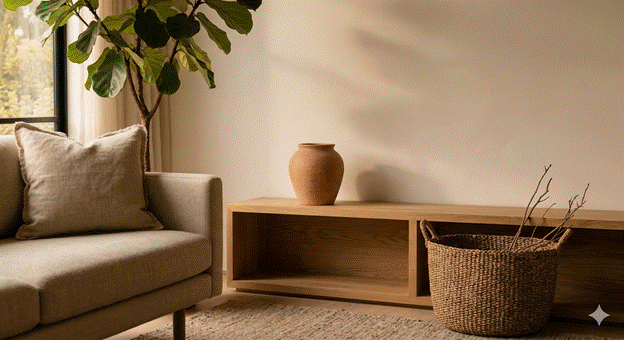
13. Bring in Organic and Natural Materials
Natural materials are the warmth of a minimalist living room — the sensory and visual qualities that prevent a restrained, edited space from feeling cold, sterile, or inhospitable. Stone, timber, rattan, jute, linen, leather, clay, and wool each bring a quality of organic warmth and tactile richness that no manufactured or synthetic material can replicate. In a minimalist living room, these materials are not decorative additions but foundational design choices.
The beauty of natural materials in a minimalist context lies in their inherent variety — no two pieces of wood grain are identical, no two handmade ceramics share the same surface quality, no two woven textiles have exactly the same texture. This organic variation creates a room of subtle, continuously surprising visual richness that rewards the close attention that a minimalist space invites.
Styling Tip: Build your natural material palette around one anchor material and two complementary ones. A room anchored in warm oak timber — floors, shelf, occasional table — complemented by natural linen textiles and raw unglazed ceramic vessels creates a beautifully coherent material story. A room anchored in pale stone — floor tiles, fireplace surround, side table — complemented by woven wool textiles and dark walnut furniture creates an equally compelling but more dramatic result. The anchor material should be the most visually prominent and most physically extensive in the room; the complementary materials add variety and depth to the anchor’s foundation.
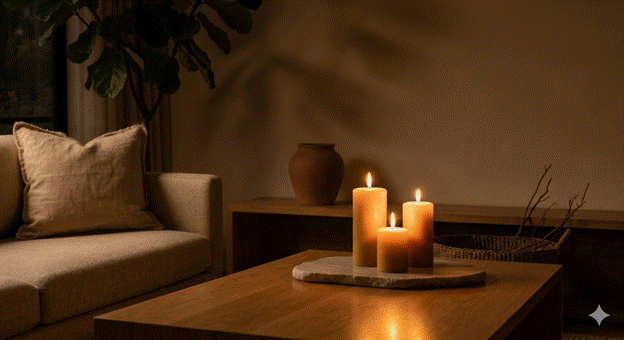
14. Add Warmth Through Candles and Soft Lighting
Candles are the minimalist living room’s most generous and most atmospheric accessory — objects that are simultaneously decorative, functional, and capable of transforming the quality of a room’s atmosphere more completely than almost any other single element. The warm, flickering light of a burning candle creates a quality of intimate, organic warmth that no electric light source can fully replicate, and in a minimalist space where every object is seen with maximum clarity, a carefully chosen candle becomes a design element of considerable importance.
Choose candles in beautifully designed vessels that function as design objects independent of their lighting function — a large matte ceramic cylinder in warm white, a hand-blown amber glass container, a concrete vessel in pale grey, or a simple beeswax pillar on a natural stone plate. The vessel is as important as the flame, and in a minimalist living room, the candle in its vessel is often the most visually precise and most deliberately chosen object in the entire room.
Styling Tip: Cluster candles in groups of three on the coffee table rather than distributing them individually across multiple surfaces — the cluster creates a single, concentrated warm light source that acts as the room’s focal point during evening hours, drawing the eye and the body toward the centre of the living space. Choose candles in a single scent profile that coordinates with the season and the material character of the room — cedarwood and amber in winter, white tea and linen in summer — to create an olfactory layer of atmosphere that completes the sensory environment the minimalist living room creates visually.
Conclusion
A minimalist living room is not a design destination but a design practice — a sustained commitment to choosing intentionally, editing regularly, and maintaining the visual quiet that makes the space genuinely restorative rather than merely aesthetic. The ideas in this collection demonstrate the extraordinary range of beauty available within the minimalist vocabulary: from the organic warmth of natural materials to the dramatic impact of a single statement artwork, from the atmospheric power of layered lighting to the grounding authority of a generously scaled rug.
The most beautiful minimalist living rooms are those that feel genuinely inhabited — rooms where the editing has been done with love rather than severity, where warmth has been built into every material and textural choice, and where the experience of being in the space is one of settled, sustained ease.
Begin with one idea from this collection. Apply it with full commitment and observe what changes. Minimalism, at its best, is a series of small, considered decisions that accumulate into something of remarkable and enduring beauty.
FAQs
FAQ 1: What defines a minimalist living room?
A minimalist living room is defined by intentional restraint in every design element — a limited colour palette built on warm neutrals, furniture chosen for quality and clean proportion rather than quantity, deliberate negative space preserved as an active design element, and storage solutions that conceal rather than display the objects of daily life. Crucially, minimalism is not about emptiness but about precision: every object in a minimalist living room has been chosen for its specific contribution to the room’s beauty, function, or both. The result is a space that feels visually calm, spatially generous, and deeply composed.
FAQ 2: How do I make a minimalist living room feel warm and not cold?
Warmth in a minimalist living room is built through three primary mechanisms: material choice, texture layering, and lighting design. Natural materials — timber, linen, wool, jute, raw ceramic, and stone — carry inherent organic warmth that synthetic alternatives cannot replicate. Layering multiple textures within a single warm neutral palette creates sensory richness without visual complexity. Warm lighting design — dimmable ambient light at reduced evening intensity, candles, and warm-toned task lighting — creates an atmospheric quality that cool or bright lighting entirely prevents. Avoiding cool-toned whites, blues, and greys in favour of warm cream, stone, and sand is the single most important colour decision for achieving warmth in a minimalist space.
FAQ 3: What colours work best in a minimalist living room?
The most successful minimalist living room colour palettes are built on warm neutrals that reflect light generously while creating a feeling of organic warmth rather than clinical sterility. Warm white, pale stone, soft cream, warm greige, dusty blush, and pale clay are the most versatile and most enduringly beautiful options. Deep, saturated tones — forest green, rich navy, warm charcoal, earthy terracotta — are used in more dramatic minimalist rooms as full-wall or cabinetry colours that create atmosphere and depth within a still highly restrained overall palette. The unifying principle is warmth of undertone: always lean warm rather than cool in minimalist colour selection.
FAQ 4: How do I declutter a living room for a minimalist aesthetic?
Decluttering a living room for a minimalist aesthetic requires two distinct phases. The first is practical removal: everything that does not belong in the living room goes elsewhere or leaves the home entirely — items that have drifted in from other rooms, objects that are stored on surfaces because they have no dedicated home, and possessions that are kept out of habit rather than genuine affection or daily use. The second phase is curatorial editing: evaluating everything that remains and deciding which objects are genuinely beautiful, meaningful, or functional enough to remain on display. Apply the three-object rule to all horizontal surfaces and commit to adequate concealed storage for everything else.
FAQ 5: What furniture is best for a minimalist living room?
The best furniture choices for a minimalist living room share a set of specific qualities: clean, unornamented lines without decorative detailing; visible legs that allow light to pass beneath and create a feeling of spatial openness; premium natural fabric upholstery in warm neutrals such as linen, boucle, or wool; and proportions that are genuinely suited to the room’s scale rather than oversized. A single well-chosen sofa of excellent quality, one or two occasional chairs, a low coffee table in natural timber or stone, and a minimal media unit with concealed storage constitute a complete minimalist living room furniture scheme. Resist the addition of pieces beyond these essentials unless they serve a function that genuinely cannot be served by existing furniture.