Introduction
The laundry room is the most quietly hardworking space in the home — a room that earns its place through relentless daily use while asking very little in return. For too long, it has been treated as purely functional: a space to be tolerated rather than designed, decorated only with practicality in mind and almost never with beauty.
That era is decisively over. The modern laundry room has emerged as one of the most compelling design opportunities in the contemporary home — a compact, purposeful space where the full vocabulary of interior design can be applied with extraordinary effect. From bespoke cabinetry and statement tile to curated open shelving and luxury pendant lighting, today’s laundry room ideas reflect a complete rethinking of what a utility space can and should look like.
The best laundry room designs are those that honour both demands simultaneously: the space must work brilliantly as a functional environment and feel beautiful enough to be opened without apology. These two qualities are not in competition. They are, in fact, deeply complementary — and the 12 ideas that follow demonstrate precisely how to achieve both at once.
Here are the top 12 laundry room ideas for stunning home inspiration — each one a practical, beautiful, and enduringly relevant blueprint for transforming your laundry space into a room you are genuinely proud to own.
1. Install Floor-to-Ceiling Cabinetry
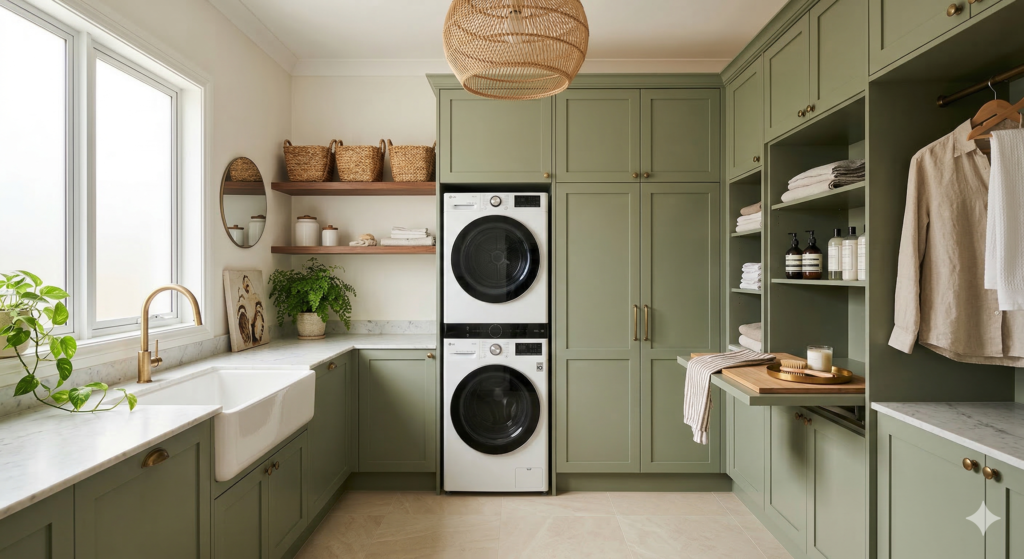
Floor-to-ceiling cabinetry is the single most transformative upgrade available to a laundry room — a design intervention that addresses storage, aesthetics, and spatial perception simultaneously with extraordinary effectiveness. By taking cabinetry from the floor to the ceiling line, the full height of the wall is activated as storage and display space, creating a room that appears considerably taller and more deliberate than its footprint might suggest.
Choose cabinet fronts in a premium finish — a smooth satin paint in a sophisticated neutral, a matte lacquer in a deep, saturated tone, or a natural timber veneer that brings warmth and organic texture to the space. The consistent vertical line of full-height cabinetry creates a strong, clean architectural presence that makes even the most modest laundry room feel designed with genuine intention.
Styling Tip: Vary the cabinet configuration deliberately between open and closed sections. Upper closed cabinets conceal less beautiful necessities — detergents, cleaning supplies, spare linens — while one or two sections of open shelving at eye level provide a curated display zone for woven baskets, ceramic vessels with lavender sachets, a trailing plant, and a folded stack of clean white towels. This mix of concealed and displayed creates a laundry room that feels considered and inhabited rather than simply fitted.
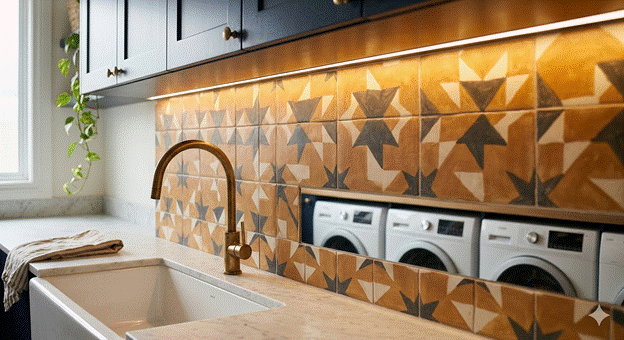
2. Choose a Statement Tile for the Floor or Splashback
Tile is the laundry room’s most immediate and most impactful design investment — the surface that sets the visual tone for the entire space with a single material decision. In a laundry room, where the practical demands of the flooring and splashback surfaces are considerable, tile is the natural and most appropriate choice. In a well-designed laundry room, it is also the most beautiful.
Statement tiles — bold geometric patterns, artisan hand-painted encaustic designs, large-format stone-effect porcelain, or a classic black and white heritage checkerboard — transform a laundry room floor or splashback from a purely functional surface into the room’s defining aesthetic feature. The specificity of the tile choice communicates design confidence and gives the room an identity that painted walls and plain cabinetry alone cannot achieve.
Styling Tip: If committing to a statement floor tile feels visually bold, introduce it as a splashback behind the machines instead — a more contained surface that still delivers the full aesthetic impact of the tile choice without the visual saturation of a full floor. A classic white subway tile in a herringbone or vertical stack pattern creates maximum elegance with minimum visual complexity. For maximum drama, choose a deep navy, forest green, or rich terracotta zellige tile that glows warmly under warm lighting.
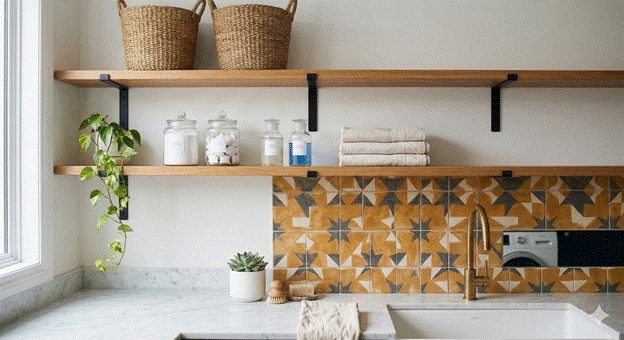
3. Add Open Shelving for Organised Display
Open shelving in a laundry room is simultaneously a practical storage solution and a significant decorative opportunity — one that, when executed with real styling intention, transforms the room’s aesthetic from purely utilitarian to quietly beautiful. Open shelves display the items they hold completely, which makes the deliberate curation of those items the primary design task.
Shelves in a warm natural timber, a painted match to the cabinetry below, or a simple powder-coated metal bracket system create a strong, clean visual line across the wall. On these shelves, the objects displayed should tell a story of considered domesticity: woven baskets in natural jute or seagrass holding sorted laundry, clear glass canisters of washing powder and softener tablets, a ceramic tray holding a small succulent, and a neatly folded stack of linen in a warm neutral.
Styling Tip: Apply the principle of three to open laundry room shelving — three zones on each shelf, varying in height and texture, with deliberate negative space between each grouping. A tall woven basket at one end, a cluster of three glass canisters at the centre, and a single trailing plant at the other end creates a shelf composition of natural, effortless beauty. Consistency in the colour of your storage vessels — all natural, all white, or all dark — creates visual coherence that elevates the shelving from functional storage to genuine room-defining decor.
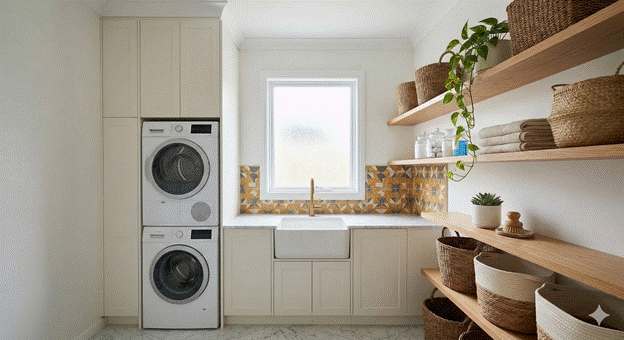
4. Maximise a Small Laundry Room with Smart Layouts
A small laundry room is one of interior design’s most genuinely rewarding spatial puzzles — a compact footprint that rewards clever thinking with results of extraordinary efficiency and beauty. The fundamental challenge of the small laundry room is not space itself but organisation: every centimetre of wall, floor, and overhead space must be considered and allocated with precision, and every piece of furniture and equipment must serve more than one purpose.
Stacking the washer and dryer vertically rather than placing them side by side is the single most impactful spatial decision available in a small laundry room — it converts a horizontal footprint of roughly 120cm into a vertical one of the same width but dramatically less floor space, freeing the adjacent area for cabinetry, a fold-down ironing board, or a compact laundry sink. A door-mounted rack for cleaning equipment and a magnetic wall strip for scissors and tools reclaim surfaces that would otherwise be cluttered with small items.
Styling Tip: In a very small laundry room, visual continuity is the primary spatial strategy — everything should be the same tone, the same finish, and the same palette to prevent the room from feeling visually fragmented. Paint walls, cabinetry, and even the ceiling in the same light neutral to create a seamless, enveloping impression of greater space. A large mirror on one wall doubles the perceived depth of the room with immediate effect and can be styled as a design element in its own right rather than purely as a spatial device.
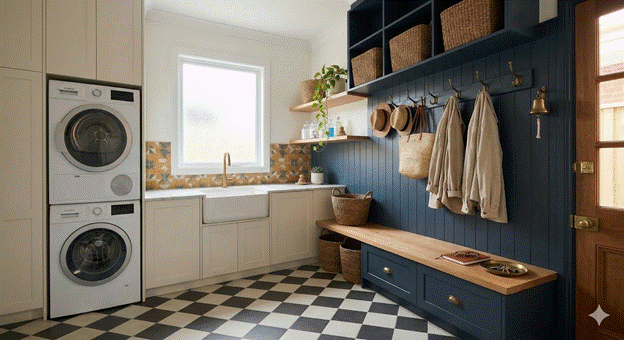
5. Create a Laundry Room with a Mudroom Combination
The laundry-mudroom combination is one of the most practically intelligent and most visually satisfying dual-purpose room designs available to the modern home. By combining the laundry’s machine-and-storage function with the mudroom’s entry-and-organisation role — coat hooks, bench seating, shoe storage, pet gear — a single room becomes a highly efficient transitional space of considerable domestic importance.
The design language of a well-executed laundry-mudroom combination is defined by its material warmth: shiplap or tongue-and-groove panelling at dado or full-wall height, natural timber bench seating with storage beneath, antique brass or matte black hooks, and a durable but beautiful floor in a natural stone, heritage tile, or quality vinyl. These materials create a space that is as hardworking as it is hospitable — a room that welcomes you home while managing every practical element of daily family life.
Styling Tip: The bench is the design centrepiece of any laundry-mudroom combination — size it generously and upholster or cushion it in a durable, washable fabric that complements the room’s palette. Beneath the bench, a combination of pull-out shoe drawers and open basket zones handles footwear and seasonal accessories simultaneously. Above the hooks, a shallow open shelf for keys, mail, and small everyday objects completes the entry organisation system in a way that feels considered and architecturally integrated rather than improvised.
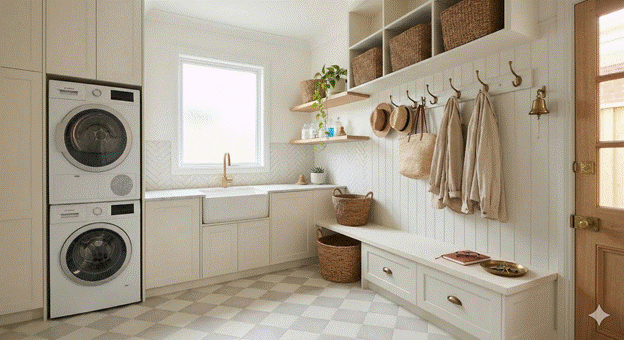
6. Use Light and Neutral Colours for a Bright Space
Colour is the most accessible and most immediately transformative tool available in a laundry room redesign, and the choice of a light, warm neutral palette is among the most reliably effective design decisions available. Light colours — warm white, pale chalk, soft cream, pale stone, or barely-there greige — reflect available natural and artificial light maximally, creating a bright, clean, open atmosphere that makes a laundry room feel genuinely pleasant to be in rather than something to be endured.
The particular warmth of the chosen neutral matters considerably. A cool, blue-toned white creates a clinical, slightly cold atmosphere that references a hospital or institutional setting. A warm, slightly creamy or greige-toned white creates a domestic, inviting atmosphere that references the clean, calm aesthetics of luxury hotel linens and Scandinavian interior design. The distinction between these two choices is small in the paint sample but large in the finished room.
Styling Tip: Introduce tonal depth into a light neutral laundry room through texture rather than additional colour. A subway tile splashback in the same white as the walls, but with a glossy finish rather than a matte one, creates a beautiful surface contrast without any additional colour complexity. Natural timber shelf brackets, a woven basket in warm natural jute, and a linen window treatment in warm oat add organic warmth to the neutral palette and prevent the room from feeling flat or characterless.
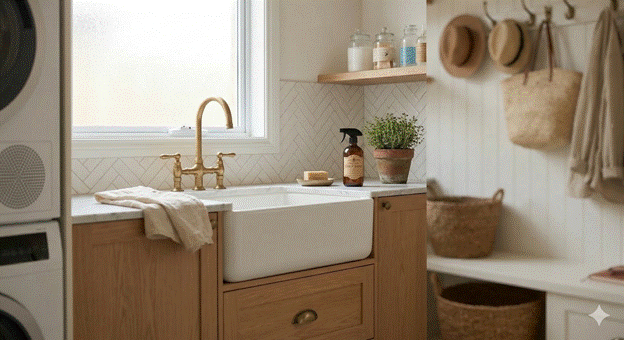
7. Add a Laundry Sink for Beauty and Function
A laundry sink — a deep, generously proportioned basin positioned beside or beneath the machines — is simultaneously one of the most practical and most aesthetically significant additions available to a laundry room. Its practical value is self-evident: hand-washing delicate items, soaking stained linens, filling buckets, rinsing mops. Its aesthetic value is less obvious but equally real — a beautiful laundry sink, particularly in a statement material or a farmhouse style, becomes a design focal point that gives the room genuine character.
The most compelling laundry sink choices are those that treat the basin as a design object rather than a purely functional fitting. A deep, wide butler’s sink in white ceramic brings a classic farmhouse warmth to the space. A concrete or stone cast basin in a warm grey adds a sophisticated, artisanal quality. A vintage-style double basin sink in porcelain with exposed brass plumbing creates an unmistakably curated aesthetic that elevates the entire room.
Styling Tip: Make the laundry sink area a styled zone in its own right by treating the wall above it as you would treat the space above a kitchen sink. A small framed print, a ceramic wall-mounted soap dispenser, a glass jar of wooden pegs, and a small potted herb create a sink vignette of genuine domestic beauty. Choose tap fittings in a warm metal finish — aged brass, brushed gold, or antique bronze — that coordinates with other metal accents throughout the room and reinforces the space’s design coherence.
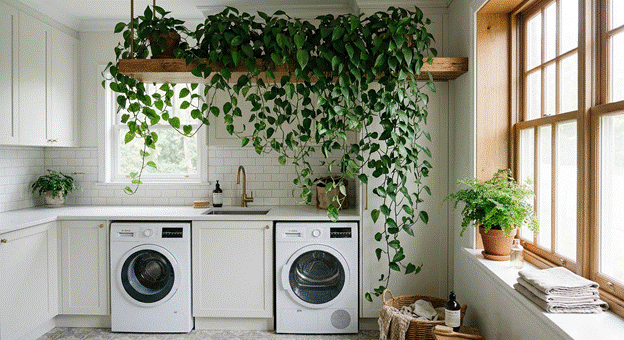
8. Incorporate Greenery and Plants
Plants in a laundry room are one of the most unexpected and most immediately effective design interventions available — an introduction of living colour, organic texture, and natural vitality into a space that most conventionally contains neither. Even a single well-chosen plant transforms the atmosphere of a laundry room from purely utilitarian to genuinely habitable, creating a quality of warmth and life that no paint colour or tile choice can fully replicate.
The laundry room’s typical environmental conditions — moderate humidity from the machines, limited natural light in many installations — make the plant selection an important consideration. Humidity-tolerant, lower-light varieties are the most reliable choices: a trailing pothos hanging from a high shelf bracket, a peace lily on the windowsill, a fern in a ceramic wall-mounted planter, or a snake plant beside the machines. Each brings life and texture with minimal maintenance requirements.
Styling Tip: Position a single large trailing plant — a Pothos or a Philodendron — on a high shelf at the far end of the laundry room, allowing the trailing stems to cascade downward over several months. This single plant, as it grows, creates a living curtain of green that softens the hard, rectilinear lines of cabinetry and machines with extraordinary naturalness. Pair with a ceramic planter in a warm white or terracotta that coordinates with the room’s broader palette, and allow the plant to grow without regular pruning for maximum trailing drama.
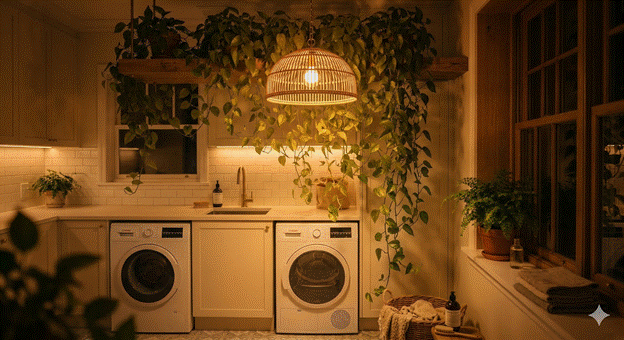
9. Install Pendant or Statement Lighting
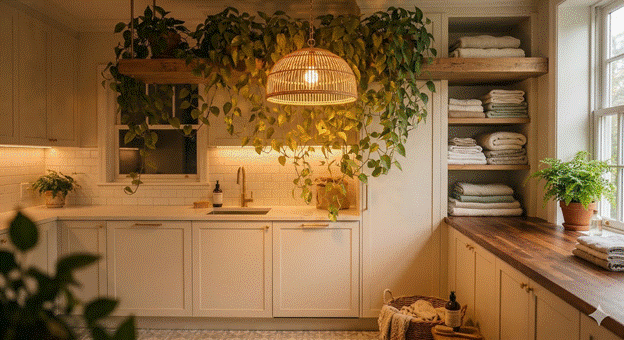
Lighting is the element that most decisively determines the atmosphere of any room — and in a laundry room, where the default is typically a single recessed ceiling fixture or a fluorescent tube, the introduction of statement lighting creates a transformation of disproportionate scale. A pendant light, a pair of wall sconces, or a linear LED fixture in a warm amber tone converts the laundry room from a utility space into a room with genuine character and designed intention.
The choice of light fitting should be made with the same design consideration applied to any other room in the home. A rattan pendant in a warm natural tone brings organic warmth and texture to the space. An aged brass dome pendant adds a note of vintage luxury. A simple black or matte white minimalist pendant creates a clean, contemporary focal point above the machines or the sink. Each choice communicates a design personality — and each is dramatically more beautiful than a standard downlight.
Styling Tip: Position a pendant light directly above the laundry sink or above the fold-and-sort counter rather than at the centre of the ceiling — this targeted positioning creates a functional pool of warm light exactly where it is most needed and creates a sense of zoned, residential lighting that makes the laundry room feel genuinely designed rather than simply installed. Pair with under-cabinet LED strip lighting in a warm 2700K temperature to provide practical task illumination at counter level without disrupting the atmosphere created by the pendant above.
10. Design a Built-In Ironing and Folding Station
A purpose-built ironing and folding station is the laundry room feature that most directly elevates the daily experience of the space — transforming a task that is typically performed on an improvised, inconvenient surface into one that happens in a dedicated, beautifully designed zone. A built-in fold-down ironing board, a generous counter surface at a comfortable standing height, and an organised storage system for the iron, the steam generator, and folded linens creates a laundry room that feels genuinely complete.
The folding counter, in particular, deserves more attention than it typically receives. A surface of adequate size — at minimum 60cm deep by 90cm wide — at a standing work height of approximately 90-95cm, in a durable material such as laminate, quartz, or butcher block timber, creates a practical and beautiful work zone that anchors the laundry room’s functional layout with genuine architectural presence.
Styling Tip: A fold-down ironing board integrated into a tall cabinetry unit — concealed behind a door that matches the surrounding cabinet fronts and opening to a full-size board at the correct working height — is one of the most elegant spatial solutions available for a laundry room. When closed, the cabinetry presents a seamless, uninterrupted face; when open, a fully functional ironing station is immediately available with no awkward assembly or storage challenge. Commission this as part of a bespoke cabinetry installation for a result that feels genuinely built-in and considered.
11. Introduce Warm Wood Tones and Natural Textures
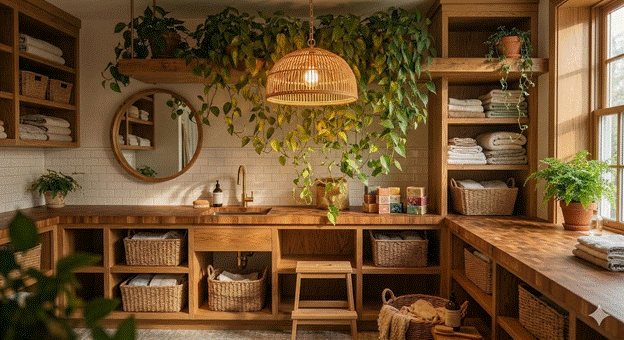
Warm timber tones and natural textures are the antidote to the coldly clinical aesthetic that laundry rooms too often default to — the design language that most powerfully signals that a utility space has been given the same warmth, consideration, and material intelligence as any other room in the home. Timber, in particular, brings an organic warmth and richness to a laundry room that no painted or laminated surface can fully replicate.
Introduce warm wood through open shelf brackets in solid oak or walnut, a butcher block counter surface, a timber-framed mirror, a natural wood step stool, or cabinetry in a warm timber veneer. Each of these elements adds a layer of organic warmth to the space that reads as genuinely considered rather than simply decorative, particularly when combined with natural textures in the storage accessories — woven baskets, linen bags, terracotta planters, and cotton rope vessels.
Styling Tip: The material relationship between the timber elements and the metal accents in a laundry room is the detail that most distinguishes a well-designed space from a merely pleasant one. Warm timber — oak, walnut, or teak — pairs most beautifully with warm metal finishes: aged brass, brushed gold, antique bronze, or warm copper. Cool grey or whitewashed timber pairs better with matte black, brushed nickel, or chrome. Maintaining consistency within one warm or one cool metallic palette across all hardware, fittings, and accessories creates a material coherence that elevates the entire room.
12. Style the Laundry Room with Considered Accessories
The accessories of a laundry room are its final and most personally expressive design layer — the objects that, through their careful selection and considered placement, communicate that this space was decorated with genuine intention and visual awareness. A laundry room styled with beautiful accessories is not a room that has been over-decorated; it is a room that has been respected.
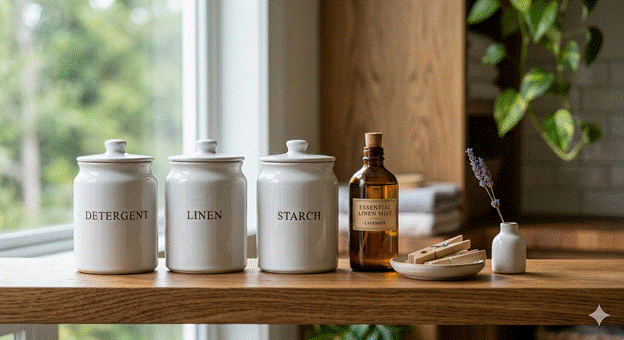
The most beautiful laundry room accessories are those that are simultaneously practical and beautiful: a set of matching glass or ceramic canisters for washing powder, softener pods, and stain remover tablets; a beautifully designed linen spray in an elegant bottle; a woven wall basket for used dryer sheets; a small ceramic dish for stray coins and buttons found in pockets; and a single framed print or piece of typography on the wall. None of these objects is expensive. All of them together create a room of considerable character.
Styling Tip: Build your laundry room accessory collection around a single consistent palette — all white ceramic, all natural seagrass, or all warm glass — and resist the temptation to introduce too many different materials simultaneously. Three well-chosen accessories in a coordinated palette create more visual impact than ten mismatched objects competing for attention. The negative space between objects on a shelf or counter is as important as the objects themselves — it allows each piece to be seen clearly and creates the quality of considered curation that distinguishes a beautifully styled laundry room from a simply organised one.
Conclusion
The laundry room is one of the home’s most frequently visited and most persistently undervalued spaces — and these 12 laundry room ideas prove, collectively, that there is no reason for it to remain either. With the right design decisions — a statement tile, beautifully organised shelving, a warm lighting scheme, a considered accessory palette, and the organic warmth of natural materials — the laundry room transforms from a space you tolerate into a space you genuinely enjoy.
The most important insight that great laundry room design offers is this: functionality and beauty are not competing demands but deeply complementary ones. A laundry room that is beautifully designed works better, feels better, and contributes more to the overall quality of daily domestic life than one that is merely practical.
Invest in your laundry room with the same intention and care you bring to the rooms guests will see. It is, after all, one of the rooms you visit most often — and you deserve to find it beautiful every single time.
FAQs
FAQ 1: How do I make my laundry room look stylish on a budget?
The most impactful budget-friendly laundry room upgrades are paint and accessories. Repainting the walls and existing cabinetry in a warm, sophisticated neutral costs very little but transforms the entire atmosphere of the space. Replacing hardware — handles, knobs, and tap fittings — in a warm metal finish such as aged brass or matte black creates an immediate quality upgrade for a modest investment. Adding open shelving, a trailing plant, and a set of matching ceramic or glass storage canisters completes a stylish laundry room refresh without requiring any structural work or significant expenditure.
FAQ 2: What is the best layout for a small laundry room?
The best layout for a small laundry room prioritises vertical storage and machine stacking wherever possible. Stacking the washer and dryer vertically frees considerable floor space for cabinetry or a compact sink. Floor-to-ceiling cabinetry on one wall maximises storage capacity without consuming additional floor area. A fold-down ironing board integrated into the cabinetry eliminates the need for a freestanding board. A wall-mounted drying rack that folds flat when not in use adds drying capacity without a permanent footprint. In very compact installations, a combined washer-dryer unit in a single machine cabinet is the most spatially efficient solution available.
FAQ 3: What colours work best for a laundry room?
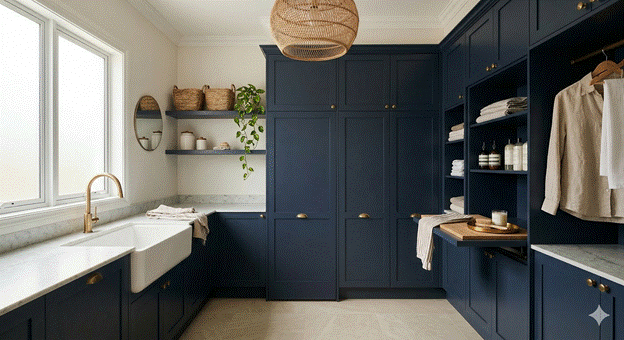
The most consistently successful laundry room colour choices are light, warm neutrals that reflect available light and create a clean, bright, inviting atmosphere. Warm white, soft chalk, pale greige, and barely-there stone are the most versatile and most broadly appealing options. For a more characterful or fashion-forward result, deep navy, forest green, or warm slate are increasingly popular choices that create a dramatic, sophisticated atmosphere while still providing a clean, practical backdrop for the room’s functional elements. Avoid cool-toned blues, greys, and whites in laundry rooms, which can create a clinical or institutional atmosphere.
FAQ 4: How do I organise a laundry room effectively?
Effective laundry room organisation is built on three principles: category separation, visual concealment of the least beautiful items, and accessibility of the most frequently used ones. Separate laundry into pre-sorted categories — lights, darks, colours, delicates — using labelled woven baskets or fabric bags on open shelves or in dedicated cabinet zones. Store detergents, fabric softeners, and cleaning supplies in matching ceramic or glass canisters that conceal their contents while looking beautiful on the shelf. Keep the iron, the drying rack, and the laundry bags within immediate reach of the machines to eliminate the friction of daily laundry tasks. Remove everything that does not belong in the laundry room entirely.
FAQ 5: What lighting is best for a laundry room?
The best laundry room lighting combines general ambient illumination with targeted task lighting at the key work surfaces. A warm pendant light or a linear LED fixture above the machines or the folding counter provides the primary atmospheric quality of the space. Under-cabinet LED strip lighting in a warm 2700K colour temperature provides practical task illumination at counter level for sorting and folding without disrupting the ambient quality of the room. Avoid cool-toned or blue-spectrum LED lighting, which creates a clinical atmosphere and makes the space feel less domestic. If the laundry room has a window, maximise the available natural light by keeping the window treatment minimal — a simple Roman blind in a warm linen rather than curtains that block the light.