Introduction
The most overlooked surface in every living room is also the one with the greatest potential.
The ceiling — that vast, uninterrupted plane above every conversation, every gathered evening, every quiet morning with a coffee and a book — is almost universally ignored in home design. Most rooms receive enormous attention at eye level: the sofa, the gallery wall, the carefully styled coffee table. And then the ceiling is simply painted white and forgotten.
But the world’s most extraordinary living rooms tell a different story.
In the most inspiring, most architecturally considered interiors, the ceiling is not background. It is design. It is the surface that draws the eye upward, that changes the perceived dimensions of the room, that creates a sense of drama, warmth, intimacy, or grandeur depending on what has been done to it with vision and skill.
A painted ceiling deepens a room’s color story. Exposed timber beams bring the warmth of natural materials to the space’s highest plane. A coffered ceiling transforms an ordinary room into one that feels architecturally distinguished. And a statement pendant or chandelier hung at exactly the right height turns the ceiling itself into a stage for light and shadow.
In this guide, we are exploring 15 stunning ceiling design living room ideas — each one a distinct approach to the fifth wall that most homeowners have yet to discover, accompanied by practical guidance on how to bring each idea to life in your own space.
Because when you finally look up, the most extraordinary room in your home is waiting.
1. The Painted Ceiling — Color Above as Drama Below
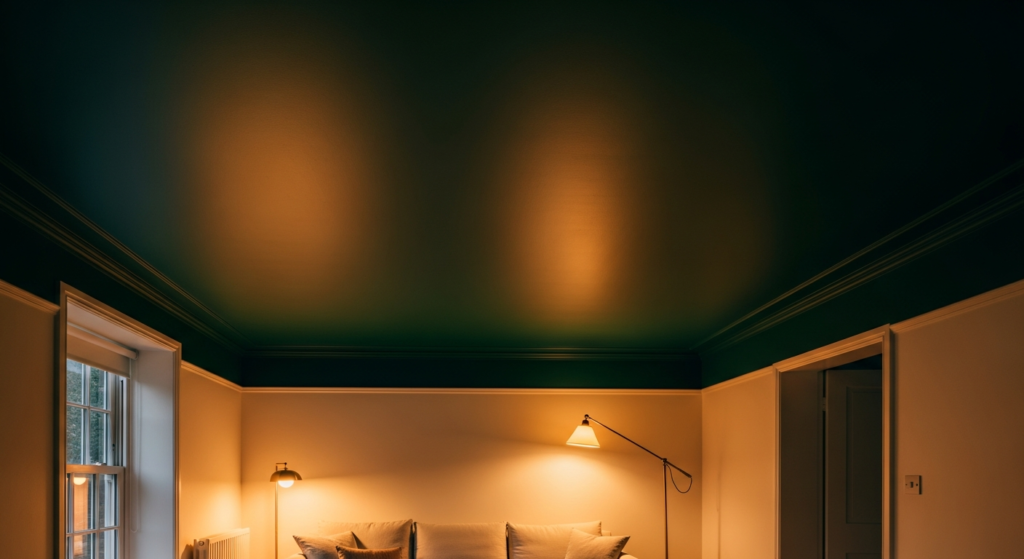
The painted ceiling is the most immediately transformative and most widely accessible ceiling design living room idea available — requiring nothing more than paint, a roller with an extension handle, and the courage to commit to color in the place where most people never think to look.
Styling Tips:
- Paint the ceiling the same deep, rich tone as the room’s accent wall for a fully immersive, cocooning effect: midnight forest green, inky navy, deep plum, and warm charcoal all create a quality of enveloping intimacy that makes a living room feel like the most beautiful and most private sanctuary.
- Alternatively, paint the ceiling a tone two shades deeper than the wall color within the same palette family — this creates a sophisticated tonal ceiling effect that adds depth and drama without the full commitment of a completely contrasting color.
- For a softer, more serene ceiling design approach, paint the ceiling in a warm blush, pale sage, or soft dusty lavender — lighter than the walls but present, warm, and deeply personal — for a room that feels wrapped rather than enclosed.
- The most common painting mistake for ceiling designs is stopping the ceiling color at the cornice or crown moulding line — for the most dramatic and most professional result, bring the ceiling color down to meet the wall color at the architectural line, painting the ceiling plane continuously to its edges.
- Finish with a flat or matte paint formula for the ceiling: this finish absorbs light rather than reflecting it, maximizes the depth of the color, and hides any surface imperfections that would be amplified by a gloss or satin finish in a ceiling application.
The painted ceiling is the ceiling design living room idea that most clearly demonstrates the transformative power of seeing your home with fresh eyes — because the moment you look at the ceiling as a design surface rather than a blank plane, everything about the room becomes possible.
2. Exposed Timber Beams — Warmth, Character, and Enduring Beauty
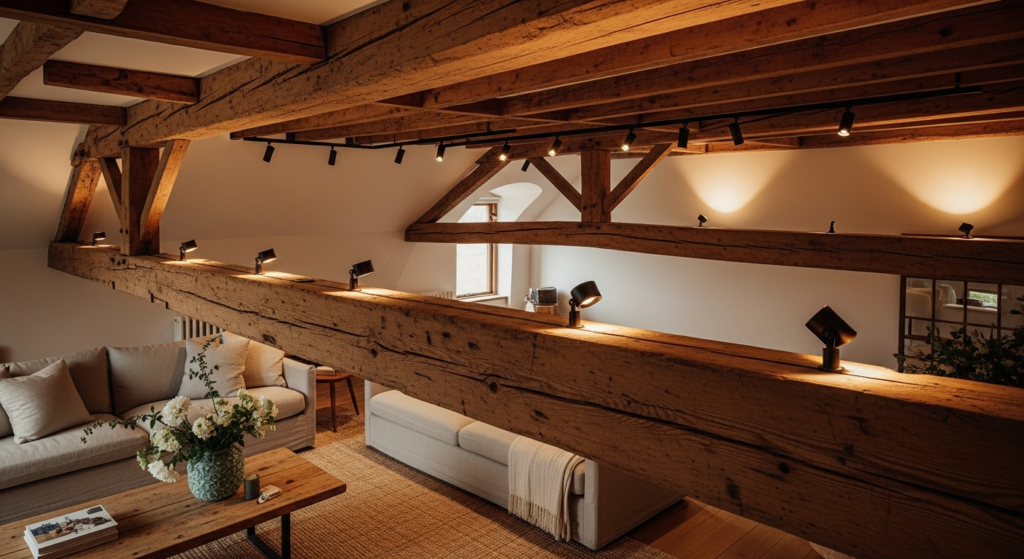
Exposed timber ceiling beams are one of the most beloved and most broadly aspirational ceiling design living room elements in contemporary interior design — bringing the warmth of natural material, the visual depth of architectural structure, and the timeless beauty of honest craftsmanship to the living room’s highest surface.
Styling Tips:
- Genuine reclaimed timber beams — salvaged from old barns, mills, or demolished structures — are the most beautiful and most characterful option: their patina, their grain variation, and the evidence of their previous life give them a quality of warmth and authenticity that new timber simply cannot replicate.
- For living rooms without structural beams, decorative faux timber beams — hollow boxes constructed from real timber or high-quality resin composites — are installed directly to the ceiling surface and produce a result visually indistinguishable from structural beams at a fraction of the cost and complexity.
- Choose beam spacing that feels architecturally appropriate to the room’s width: beams spaced at approximately 30 to 40 percent of the ceiling width create the most visually balanced and most naturally proportioned result for most living room scales.
- Finish exposed beams in a treatment that serves the room’s design direction: a light natural wax finish for Scandinavian or Japandi aesthetics, a deep walnut stain for mid-century or dramatic interiors, or a whitewashed or limewashed treatment for coastal and cottage living room styles.
- Complement exposed beams with warm, directional lighting installed between them: recessed spots or track lighting mounted between beam runs illuminate the beam structure from below, creating dramatic sculptural shadows that make the ceiling design a feature at every hour of the day.
Exposed timber beams are the ceiling design living room element that most completely connects the interior to something larger and more permanent than the current moment — to craft, to nature, and to the history of shelter itself.
3. Coffered Ceilings — Architectural Authority and Classical Elegance
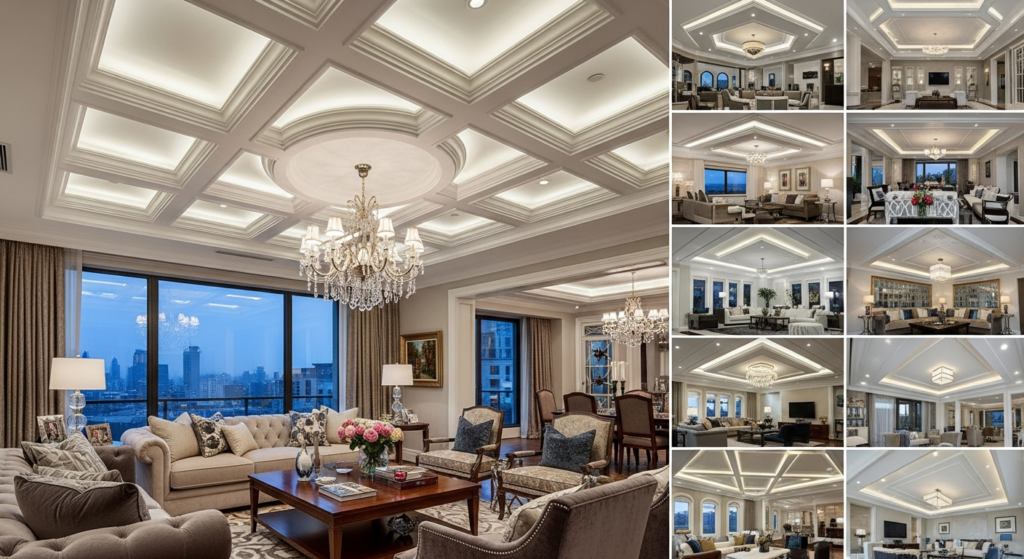
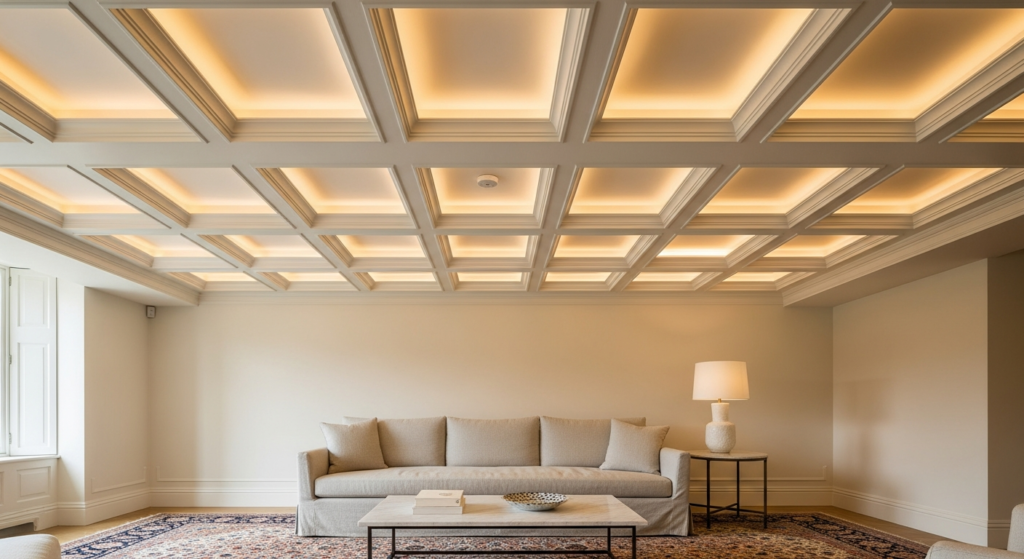
The coffered ceiling — a grid of recessed panels created by intersecting beams or applied moulding — is one of architecture’s most historically distinguished and most timelessly beautiful ceiling design living room solutions, lending a quality of structural intelligence and classical elegance to any space it graces.
Styling Tips:
- Traditional coffered ceilings are constructed from timber or plasterwork creating true recessed panels between structural or applied beams. A more accessible modern interpretation uses flat MDF or timber moulding applied directly to the ceiling surface to create the visual impression of coffering without the structural requirements.
- Paint the coffered ceiling in a single tone — either matching the walls for a quiet, architectural result or in a contrasting deeper shade for a more dramatic interpretation — rather than differentiating between the beam framework and the recessed panels, which can read as visually complicated rather than refined.
- For a contemporary update on the classical coffered ceiling, use a very simple, widely spaced grid with minimal moulding profile — the restraint of the modern interpretation maintains the architectural quality of the design while feeling current rather than period-specific.
- Install recessed lighting within the coffered panels for the most architecturally integrated and most dramatically beautiful ceiling design lighting result: the light wells within each panel create a rhythm of illumination and shadow that emphasizes the coffering’s depth.
- Coffered ceilings work most beautifully in living rooms with ceiling heights of at least nine feet — in lower-ceilinged rooms, coffering can create a sense of compression; in taller rooms, it scales the ceiling down to a more human and intimate proportion.
The coffered ceiling is the ceiling design living room choice that most clearly communicates architectural intention — the decision to treat the ceiling not as a structural necessity but as an opportunity for genuine design excellence.
4. Shiplap Ceiling — Casual Warmth with Serious Visual Impact
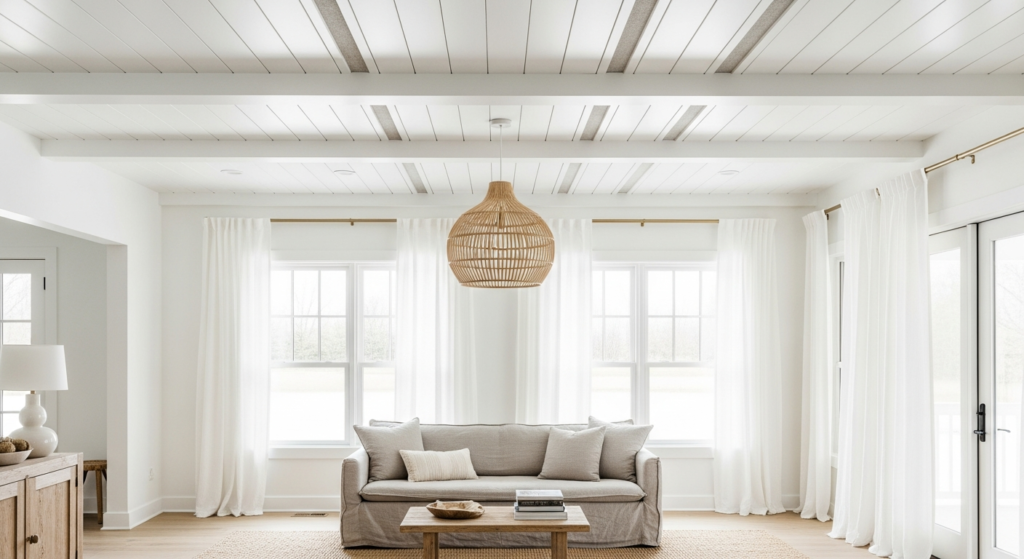
The shiplap ceiling — horizontally or vertically applied timber planks with distinctive shadow gaps between each board — has become one of the most widely reproduced and most genuinely beloved ceiling design living room ideas across the entire spectrum of contemporary interior design, from coastal cottages to urban apartments to rural farmhouses.
Styling Tips:
- Shiplap planks installed horizontally along the ceiling’s length create a sense of visual extension, making the room feel longer and more expansive. Vertical installation draws the eye toward one end of the room, creating a focal wall effect at ceiling height.
- Choose shiplap in a finish that serves the overall room aesthetic: a natural pine or pale ash for a Scandinavian or biophilic direction, a painted white for a coastal or cottage interpretation, a whitewashed treatment for a relaxed farmhouse quality, or a deep charcoal or painted deep tone for a more dramatic ceiling design statement.
- The characteristic shadow gap between shiplap boards — typically between 3mm and 8mm — creates subtle lines of shadow that add visual texture and depth to the ceiling surface even when the planks themselves are painted a solid color.
- Combine a shiplap ceiling with a statement pendant light hung at the center: the contrast between the organic, textured timber planks and the clean, sculptural form of a pendant is one of ceiling design living room’s most photographed and most beautiful combinations.
- A painted white shiplap ceiling immediately transforms the visual quality of any living room — even in spaces where the walls and floor are otherwise unremarkable — by adding the kind of architectural interest and textural depth that transforms a room from merely functional to genuinely characterful.
The shiplap ceiling brings the warmth and honesty of natural material to the plane most people overlook — and in doing so, changes the way an entire living room feels to inhabit.

5. The Statement Chandelier — Light as Architecture
The statement chandelier is the ceiling design living room idea that produces the highest impact per pound of investment — a single, extraordinary light fitting that, hung at the correct height above the room’s primary gathering point, transforms the visual character of the ceiling, defines the room’s spatial center, and creates a quality of light and shadow that no other design element can achieve.
Styling Tips:
- Choose a chandelier diameter that is appropriately scaled to the room: a general rule is to add the room’s dimensions in feet (length plus width) and convert to inches for the appropriate chandelier diameter. A 15 by 18 foot room calls for a chandelier of approximately 33 inches in diameter.
- Hang the chandelier at a height that creates presence without obstruction: in rooms with standard 8 to 9 foot ceilings, the bottom of the chandelier should hang approximately 7 feet from the floor. In rooms with 10 foot or higher ceilings, hang the chandelier higher to maintain proper visual proportion.
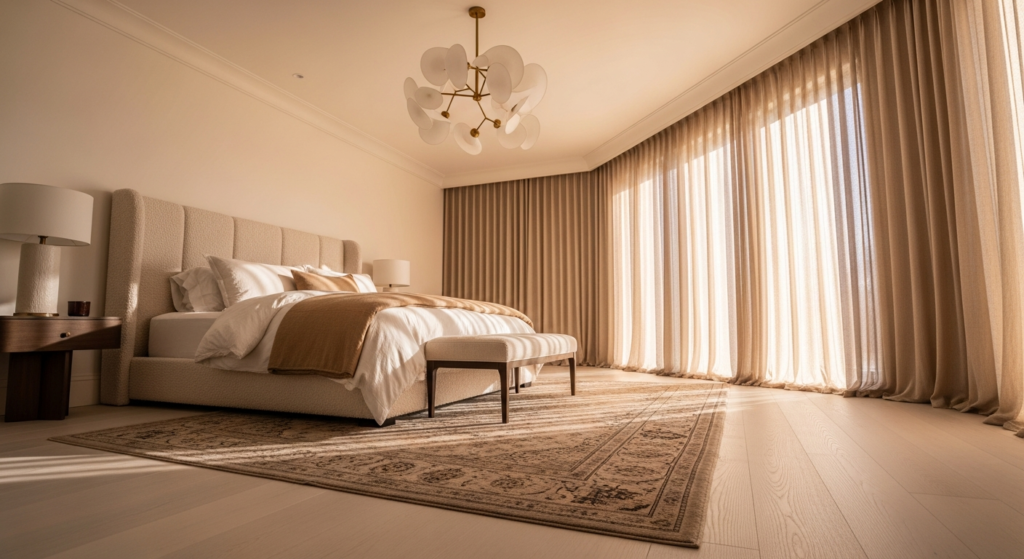
- The chandelier’s style should be the most deliberate and the most character-rich design choice in the room: a branching sculptural chandelier in raw brass for a maximalist or mid-century living room; a cluster of hand-blown glass globes for a contemporary and airy direction; a rattan or wicker orb for a coastal or Japandi aesthetic; or a classic crystal chandelier for a traditional or romantic interior.
- Always wire a statement chandelier to a dimmer switch — the ability to adjust the chandelier’s light level from bright morning illumination to intimate evening atmosphere is the single most important functional upgrade available to any ceiling design lighting scheme.
- Consider the shadow pattern the chandelier casts as part of its design value: a chandelier that creates beautiful shadows on the ceiling and walls at night is a light fitting that functions as both illumination and art.
The statement chandelier is the ceiling design living room idea that most clearly demonstrates that light is not simply a functional requirement but one of interior design’s most powerful, most transformative materials.
6. The Tray Ceiling — Layered Depth and Architectural Refinement
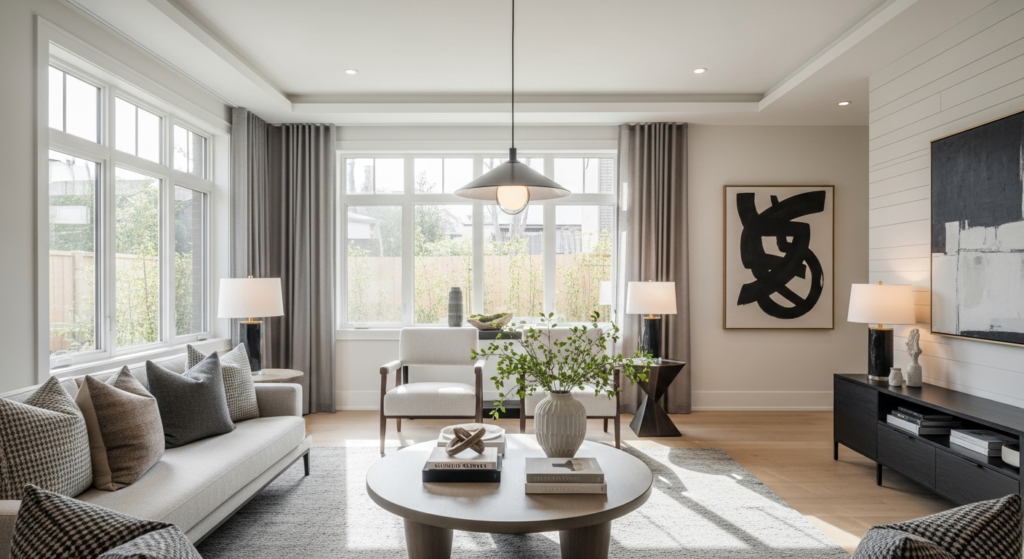
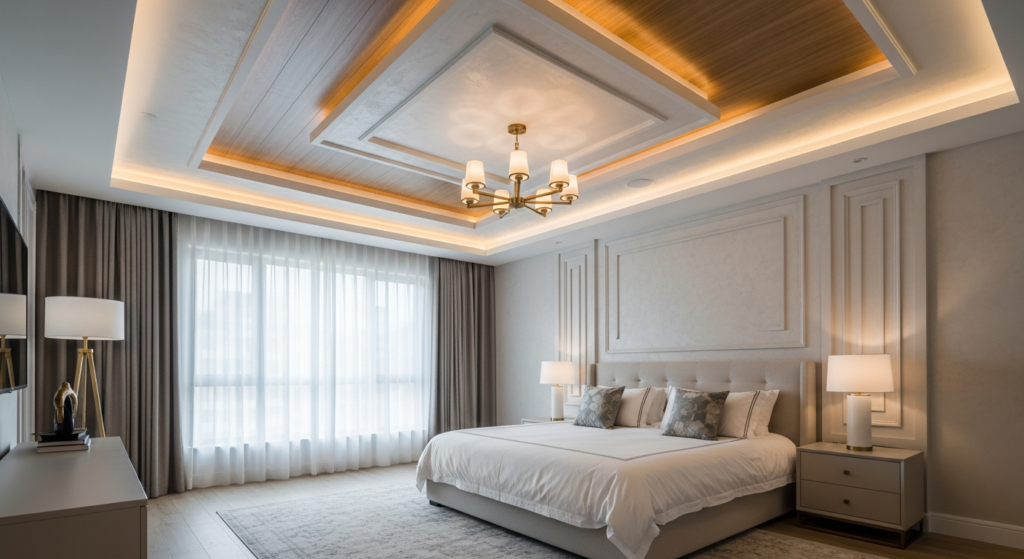
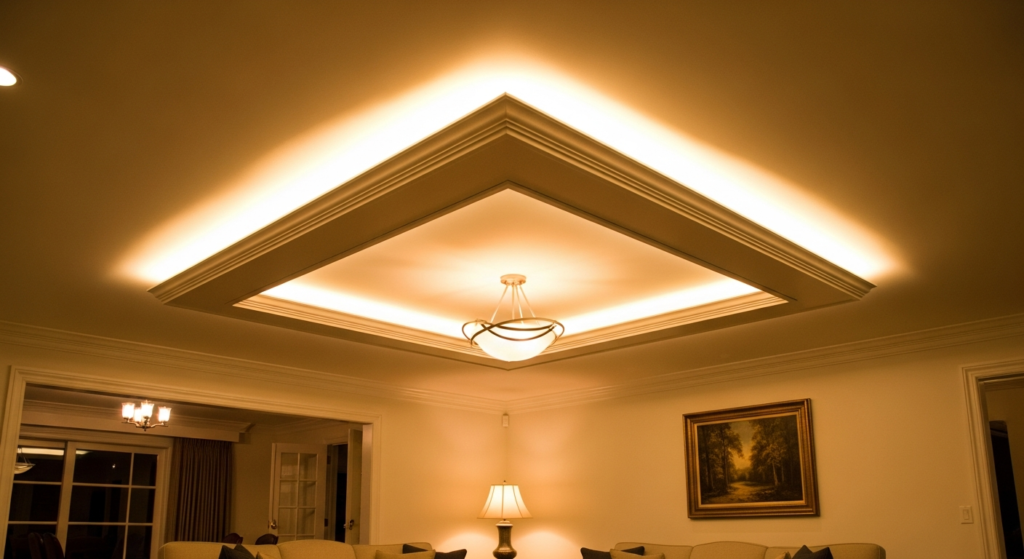
The tray ceiling — a recessed central section of ceiling that sits higher than the surrounding perimeter, creating a step or series of steps that add architectural depth and visual interest to what would otherwise be a flat plane — is one of the most elegant and most architecturally sophisticated ceiling design living room ideas available without structural renovation.
Styling Tips:
- The most beautiful tray ceiling designs use the stepped perimeter as a lighting installation zone: LED strip lighting installed within the tray’s inner step and directed upward creates a soft, indirect ambient glow that emanates from within the ceiling itself, washing the upper walls and ceiling in warm, diffused light with no visible source.
- Paint the recessed center panel of the tray ceiling in a deeper tone than the surrounding perimeter step — this accentuates the tray’s depth and adds the quality of architectural dimension that makes tray ceilings so distinctive and so photographically beautiful.
- In a living room with a tray ceiling, position a statement pendant or chandelier within the recessed central panel: the ceiling already functions as a frame for the light fitting, and the combination of the architectural tray and the pendant creates one of the most elegant and most composed ceiling design moments available.
- The step height of a tray ceiling — the vertical dimension of the step between the recessed panel and the perimeter — affects the design dramatically: a deeper step (8 to 12 inches) creates the most dramatic architectural effect; a shallower step (4 to 6 inches) reads as more subtle and more contemporary.
- Complement the tray ceiling’s architectural linearity with a circular or sculptural pendant centered within the recessed panel — the contrast between the ceiling’s geometric structure and the pendant’s organic or curved form creates the most visually interesting and most design-intelligent ceiling composition.
The tray ceiling is the ceiling design living room idea that most elegantly demonstrates the architectural possibilities of the space above — transforming a flat surface into a layered, dimensional design statement.
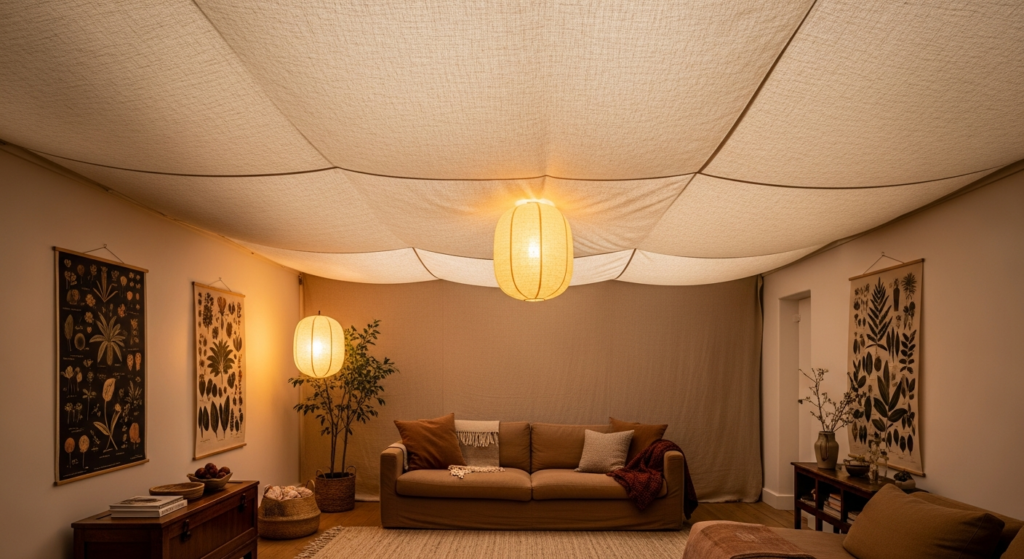
7. Stretched Fabric Ceiling — Soft, Textural, and Completely Unexpected
The stretched fabric ceiling — a tensioned textile membrane installed across the ceiling surface in place of plaster or paint — is one of the most innovative and most visually extraordinary ceiling design living room ideas in contemporary interior design. It is the design choice that genuinely surprises, creating a quality of soft luxury and acoustic warmth that no painted or plastered ceiling surface can achieve.
Styling Tips:
- Choose ceiling fabric in a tone that harmonizes with the room’s overall palette: a warm ivory or linen white for a soft, romantic quality; a deep charcoal or navy for a dramatic, theatrical effect; or a warm sand or stone tone for an organic, earthy aesthetic.
- Natural and natural-effect fabrics — linen, canvas, or fine-gauge burlap — add a textural quality to the ceiling that reflects diffused light beautifully and creates a warm, organic atmosphere in the living room below.
- A gathered or draped fabric ceiling — where the fabric is allowed to pleat and gather rather than being stretched tautly — creates an even more dramatic and more romantic ceiling design effect, particularly beautiful in maximalist or bohemian living room aesthetics.
- Install warm-toned lighting above or behind the fabric membrane where possible: a fabric ceiling glows with extraordinary warmth and beauty when lit from behind or above, creating a lantern-like quality of diffused luminosity throughout the room.
- The acoustic benefits of a fabric ceiling are a significant practical advantage in open-plan living rooms: the textile surface absorbs sound rather than reflecting it, dramatically improving the acoustic comfort of the space.
The stretched fabric ceiling is the ceiling design living room idea that most completely transforms the nature of the surface itself — from a hard, acoustically reflective plane into something soft, warm, and genuinely extraordinary.
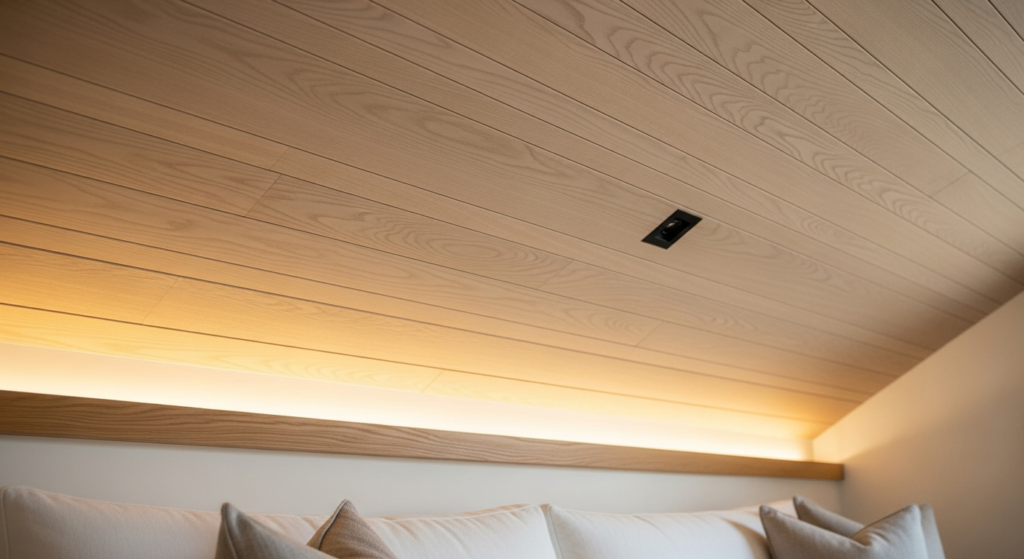
8. Tongue and Groove Ceiling — Classic Craftsmanship Elevated
The tongue and groove ceiling — constructed from interlocking timber planks applied to the ceiling surface — is one of interior design’s most enduringly beautiful and most richly textural ceiling design living room ideas, carrying the quality of traditional craftsmanship into contemporary interiors with results that feel simultaneously timeless and genuinely current.
Styling Tips:
- Choose tongue and groove plank width based on the ceiling’s scale: narrow boards (2 to 3 inches wide) create a finer, more delicate texture that reads as refined and contemporary; wider boards (4 to 6 inches) create a more rustic, bolder texture with more visual drama.
- Apply the planks in a direction that emphasizes the room’s best dimension: running planks along the length of the room visually extends it; running them across the room’s width adds perceived breadth to a narrower space.
- A painted tongue and groove ceiling — particularly in a bright white or warm ivory — creates the coastal or cottage living room’s most characteristic and most beloved ceiling treatment, adding texture and depth while maintaining the lightness and airiness of a light-toned surface.
- For a more dramatic and more contemporary application, apply tongue and groove in a naturally finished or dark-stained timber that creates a rich contrast against lighter walls and provides a distinctly architectural, materially honest ceiling design quality.
- Install recessed lighting between plank runs for the most integrated and most architecturally considerate ceiling design lighting approach — the light sources disappear into the plank structure, illuminating the space without competing with the textural beauty of the timber surface.
The tongue and groove ceiling is the ceiling design living room choice of those who understand that genuine craftsmanship — the honest use of natural material, applied with skill and care — is always the most beautiful and most enduring form of decoration.
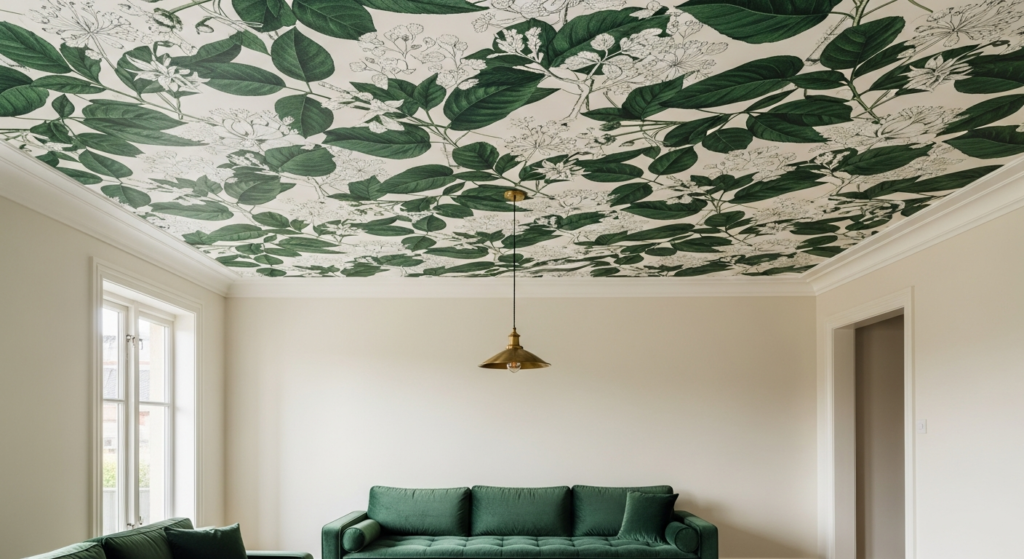
9. Wallpapered Ceiling — Pattern, Drama, and the Unexpected
Wallpapering the ceiling is one of interior design’s most gloriously unexpected and most dramatically beautiful ceiling design living room ideas — taking the pattern, richness, and visual weight of wallpaper from the vertical plane where it is conventionally used and installing it above, creating a room that feels simultaneously enclosed in beauty and entirely unlike anything the visitor expected.
Styling Tips:
- Choose a ceiling wallpaper pattern that complements rather than directly matches any wallpaper used on the walls: a wallpapered ceiling in a smaller-scale version of a wall pattern, or in a coordinating but distinct design from the same collection, creates visual coherence without monotony.
- Large-scale botanical prints, geometric patterns, and traditional damask or toile designs all work beautifully as ceiling wallpapers — the scale of the ceiling gives large patterns room to breathe and be read without the visual crowding that can occur on wall applications.
- Keep the room’s walls and furniture simple when using a wallpapered ceiling: the ceiling is the statement, and the most beautiful and most balanced wallpapered ceiling rooms are those where the walls and floor provide a restrained, quiet backdrop against which the ceiling’s pattern reads with full visual clarity.
- Use a heavy-duty paste or ceiling-specific wallpaper adhesive for ceiling applications — ceiling installation requires a more robust bonding agent than wall applications due to the gravitational challenges of working overhead.
- Consider metallic or foil-print ceiling wallpapers for a ceiling design living room effect of extraordinary luminosity: these papers catch and reflect light as the angle of illumination changes throughout the day, creating a ceiling that appears to shift and shimmer with the movement of natural light.
The wallpapered ceiling is the ceiling design living room idea for those brave enough to look up and see not a surface to be finished but a canvas to be celebrated — the most dramatic and most personally expressive design decision the ceiling offers.
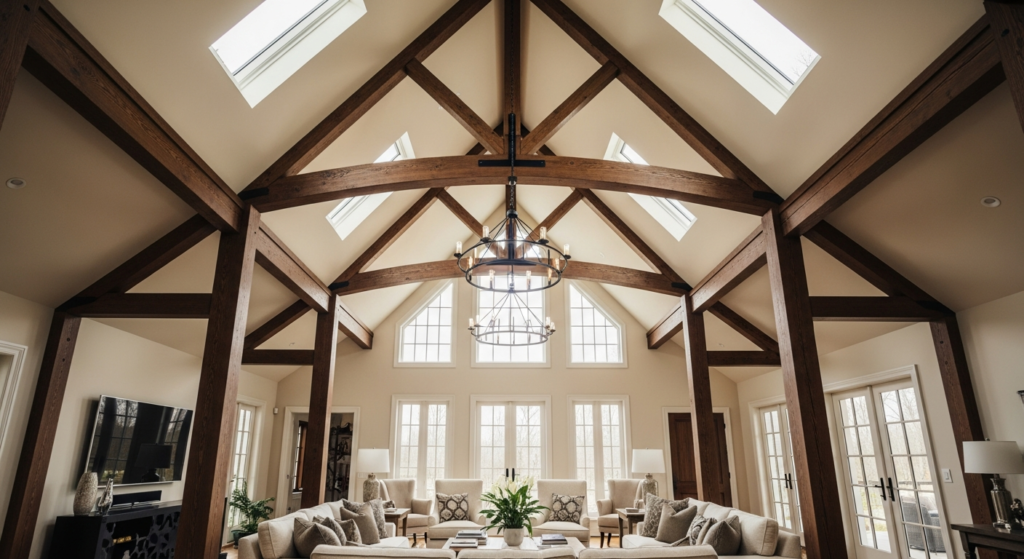
10. The Vaulted Ceiling — Soaring Grandeur and Natural Magnificence
The vaulted or cathedral ceiling is architecture’s most generous gift to the living room — a soaring, sky-reaching plane that transforms the spatial quality of any room it graces from simply contained to genuinely expansive, from comfortable to extraordinary.
Styling Tips:
- In a living room with existing vaulted ceilings, celebrate the height rather than attempting to compensate for it: choose tall furniture pieces (a floor-to-ceiling bookshelf, an oversized artwork, a large pendant hung from the apex), and use the vertical space between the top of the furniture and the ceiling peak as a design zone rather than empty void.
- Install a dramatic pendant or chandelier hung from the vault’s highest point at a height that maintains presence without appearing to float disconnectedly — in a very high vault, multiple pendants hung at varying heights create a sculptural ceiling installation that fills the vertical space beautifully.
- Use the vaulted ceiling’s natural lighting advantage: clerestory windows installed at the vault’s upper reaches flood the living room with natural light from above throughout the day, creating the quality of illumination that is one of vaulted ceilings’ most extraordinary design gifts.
- Expose or emphasize the structural elements of the vault — the ridge beam, the rafters, the collar ties — where architecturally visible, as these elements add visual richness and honest structural beauty to the vaulted ceiling’s already dramatic impact.
- Paint the vault ceiling in a warm, slightly off-white or pale warm tone rather than a cold pure white — the height of a vaulted ceiling can feel distant and institutional in a stark white; a warm tone brings the ceiling into relationship with the room below while maintaining its soaring quality.
The vaulted ceiling is the ceiling design living room gift that keeps giving — a spatial generosity that changes the quality of every moment experienced beneath it, making ordinary life feel, somehow, more expansive.
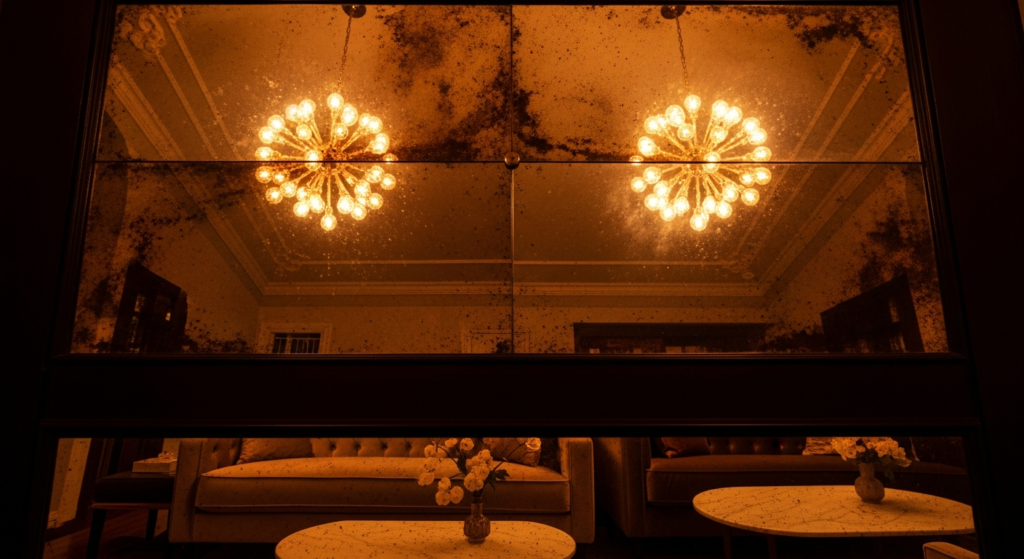
11. The Mirrored Ceiling — Glamour, Light, and Visual Infinity
The mirrored ceiling panel — applied to all or part of a living room ceiling in polished mirror, antiqued mirror glass, or a reflective metallic finish — is one of interior design’s most dramatically glamorous and most provocative ceiling design living room ideas, creating a quality of spatial multiplication and luminous complexity that no other ceiling treatment can replicate.
Styling Tips:
- Antique mirror glass — with its characteristic warm patina, its slight cloudiness, and its softly distorted reflections — creates a far more beautiful and far more appropriate ceiling design result for most residential living rooms than polished mirror, which can feel clinical and overwhelming in a domestic context.
- Apply mirrored ceiling panels to a partial rather than full ceiling area for the most refined and most manageable result: a central section of mirror framed by plaster or moulding, or a mirrored ceiling panel above a specific seating zone, creates a glamorous effect without the visual overwhelm of a fully mirrored ceiling.
- A mirrored ceiling works most beautifully when it reflects something extraordinary in the room below: a beautiful chandelier, a gallery wall, or an extraordinary arrangement of furniture and objects all become doubly visible in the mirrored reflection, creating a quality of layered visual richness.
- Install warm-toned lighting that is reflected in the mirror surface: the doubled reflection of warm amber light sources creates an extraordinary atmosphere that makes mirrored ceilings most beautiful in the evening hours.
- A coffered or framed ceiling design that incorporates mirror as one panel element within a broader architectural framework — rather than simply applying mirror to the flat ceiling surface — creates the most refined and most genuinely architectural version of this dramatically glamorous ceiling design idea.
The mirrored ceiling is the most unapologetically glamorous ceiling design living room idea in this guide — the choice of those who believe that luxury, when applied with genuine design intelligence, is always worth the extraordinary visual richness it creates.
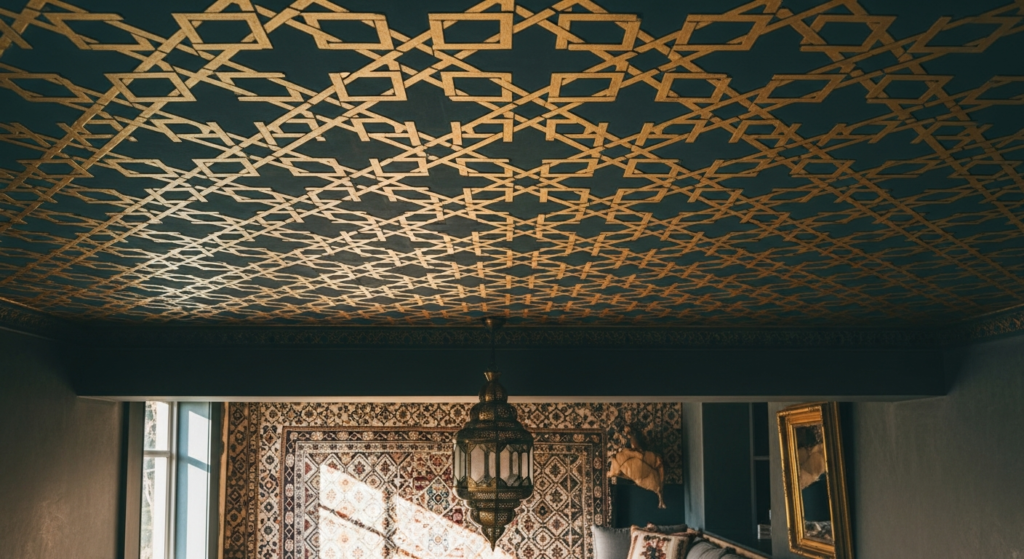
12. The Stenciled Ceiling — Hand-Crafted Pattern and Artisanal Beauty
The stenciled ceiling — where a repeating pattern is applied to the ceiling surface using paint and a precision stencil — is one of the most personally expressive, most artisanal, and most genuinely beautiful ceiling design living room ideas available to those who want the visual impact of a patterned ceiling without the cost and permanence of wallpaper.
Styling Tips:
- Choose a stencil pattern that references the room’s overall design direction: a geometric Moorish or Mediterranean pattern for a maximalist or bohemian room; a delicate botanical repeat for a romantic or biophilic living room; a classic damask or heraldic pattern for a traditional or grandeur-seeking space; or a simple chevron or hex tile pattern for a contemporary and clean ceiling design.
- Apply the stencil in a metallic paint — gold, copper, or silver — over a matte painted ceiling base for the most dramatic and most luxurious stenciled ceiling result: the contrast between the flat, light-absorbing base and the light-catching metallic pattern creates a ceiling of extraordinary visual richness.
- Alternatively, a tone-on-tone stencil application — where the stencil is applied in a finish (gloss or sheen) over a matte base in the same color — creates a more subtle and more sophisticated ceiling pattern that reveals itself gradually as the light across the ceiling surface changes throughout the day.
- For a ceiling stencil on a low budget, use a self-adhesive craft stencil and a dense foam roller to apply the pattern — the process is time-consuming but entirely achievable without professional assistance and produces a result of genuine beauty and personal character.
- Complete the stenciled ceiling with a complementary pendant light at its center that references the stencil pattern’s cultural or aesthetic origin — a Moroccan lantern above a Moorish geometric stencil, or a simple globe pendant above a botanical repeat — for a ceiling design living room composition of genuine coherence and beauty.
The stenciled ceiling is ceiling design made personal — the choice to create, by hand and with care, a pattern that belongs entirely to the room and the person who made it.
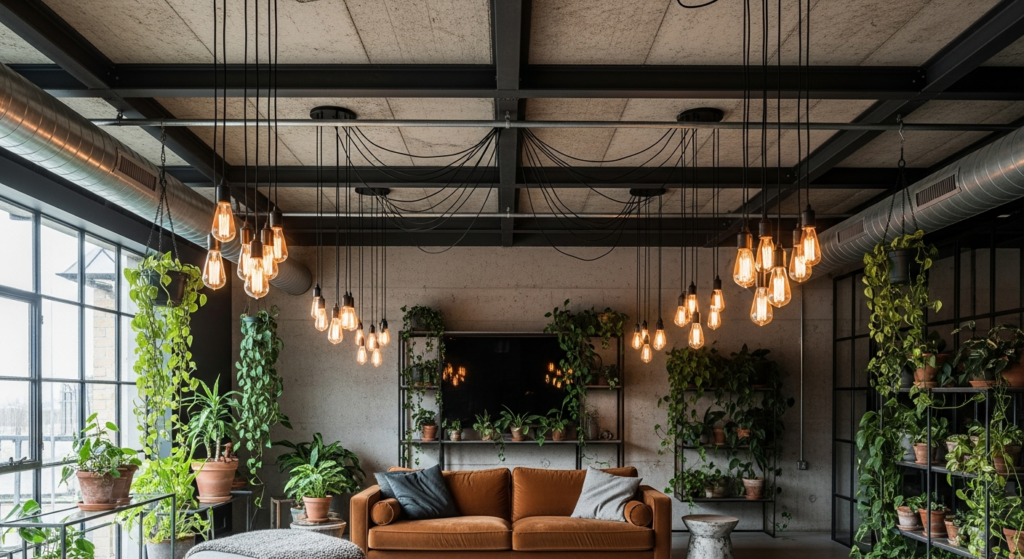
13. The Industrial Ceiling — Raw, Honest, and Quietly Dramatic
The exposed industrial ceiling — where structural elements including concrete slabs, steel beams, ductwork, and service pipework are revealed and celebrated rather than concealed behind plaster — is one of contemporary interior design’s most distinctive and most influentially reproduced ceiling design living room ideas, turning functional infrastructure into one of the room’s most compelling and most characterful design features.
Styling Tips:
- The most important decision for an industrial ceiling design in a living room is consistency of finish: paint all exposed structural and service elements in a single color — matte black, deep charcoal, or a warm dark grey — to unify the varied pipes, ducts, and beams into a coherent, intentional design statement rather than a collection of exposed utilities.
- Expose concrete ceiling slabs where architecturally possible, and treat the surface with a concrete sealer for a clean, smooth finish — raw concrete in a living room ceiling creates an extraordinary quality of honest material beauty that no other surface can replicate.
- Industrial ceilings work most beautifully in living rooms with genuinely generous ceiling heights (10 feet or more) that allow the structural elements to be seen from a comfortable distance — in lower-ceilinged spaces, an exposed industrial ceiling can feel oppressive rather than dramatic.
- Warm the industrial ceiling with warm-toned lighting: Edison bulb pendant clusters, track lighting in matte black or brushed brass, and floor lamps create a quality of amber warmth that counteracts the inherent coolness of concrete and steel beautifully.
- Counterbalance the ceiling’s industrial rawness with genuinely soft and warm elements below: a deep velvet sofa, a thick wool rug, abundant plants, and warm timber furniture all create the productive tension between raw ceiling and warm room that defines the industrial living room aesthetic at its most beautiful.
The industrial ceiling is the ceiling design living room idea for those who find beauty in honesty — in the exposed truth of how a building is put together, and in the extraordinary aesthetic that emerges when structure is celebrated rather than hidden.
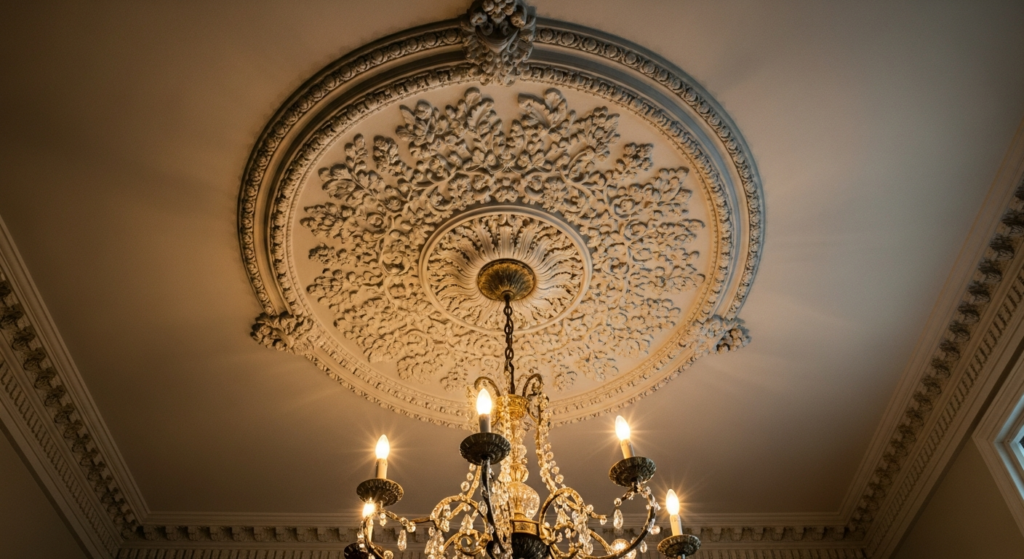
14. The Medallion and Plasterwork Ceiling — Classical Ornament Revived
The plaster ceiling medallion — a circular ornamental plasterwork piece installed around the base of a ceiling light fitting — is one of interior design’s most enduringly beautiful and most timeless ceiling design living room details, capable of adding a quality of classical refinement and decorative richness to even the most contemporary and minimally styled space.
Styling Tips:
- Choose a medallion size that is proportionate to both the pendant or chandelier it surrounds and the ceiling’s overall scale: a medallion with a diameter approximately equal to the chandelier’s spread creates the most balanced and most visually integrated result.
- Pre-made polyurethane ceiling medallions — available in an extraordinary range of ornamental profiles and detail levels — are lightweight, easy to install with construction adhesive, and produce a result visually indistinguishable from traditional plasterwork at a fraction of the cost.
- Paint the medallion the same tone as the ceiling for a subtle, sophisticated integration — the shadow detail of the ornamental relief creates interest without the medallion reading as a separate decorative object applied to the ceiling.
- Alternatively, paint the medallion in a contrasting tone — deep navy, warm gold, or matte black against a white ceiling — for a ceiling design living room statement of genuine boldness and decorative confidence.
- Extend the plasterwork ceiling design concept beyond the central medallion: a perimeter cornice or crown moulding profile, even at its most minimal, gives any living room ceiling a quality of architectural finish and completion that dramatically elevates the room’s overall refinement.
The ceiling medallion is the ceiling design living room detail that rewards the closest attention — a small ornamental choice that speaks to a love of craft, beauty, and the particular pleasure of a room finished with genuine, careful intention.

15. The Sky Ceiling Mural — Living Room Canopy of Infinite Beauty
The sky ceiling mural — a painted or photographic representation of sky, clouds, stars, or a botanical canopy applied to the entire ceiling surface — is the most visually extraordinary and most profoundly atmospheric ceiling design living room idea in this guide, transforming the overhead plane into a view of the natural world that changes the entire emotional character of the room below it.
Styling Tips:
- A professionally executed hand-painted sky mural — whether a soft blue-and-white day sky, a dramatic golden sunset, a deep midnight sky scattered with stars, or a botanical canopy of painted branches and leaves — is one of the most remarkable and most personal ceiling design investments a living room can receive.
- For a more accessible and equally beautiful result, high-quality ceiling mural wallpapers in photographic sky or botanical images are widely available in self-adhesive or paste formats that can be installed by a skilled amateur without professional assistance.
- The most beautiful and most broadly loved sky ceiling mural interpretations for living rooms include: a soft impressionistic cloud study in blue and white for a serene, airy quality; a gold-leaf star ceiling for maximum evening glamour; a painted garden canopy of wisteria, jasmine, or flowering branches for a botanical, romantic atmosphere; and a deep ultramarine night sky with silver stars for a cocooning, magical quality.
- Keep the living room’s walls and furnishings in simple, restrained tones when installing a sky ceiling mural — the ceiling is the room’s entire statement, and everything below it should function as the quiet, calm setting from which the extraordinary overhead view can be fully appreciated.
- Install warm, indirect lighting around the ceiling perimeter — concealed LED strips set into a cornice or ceiling tray — that illuminates the mural from below in a warm glow, creating a quality of dawn or dusk light that makes the sky ceiling most extraordinarily beautiful in the evening hours.
The sky ceiling mural is the most poetic of all ceiling design living room ideas — the transformation of the most mundane of architectural surfaces into an act of pure wonder, a daily reminder that beauty and imagination, applied together with courage, can make any room feel like the most extraordinary place on earth.
Conclusion
The ceiling has always been there, quietly offering itself as the most generous and most patient canvas in your home.
Every morning you have looked past it. Every evening its potential has waited, unchanged, above every conversation and every quiet moment. And now, having seen what fifteen different design approaches can do with that single surface — what color, material, pattern, light, and vision can achieve — the ceiling is no longer invisible.
The 15 ceiling design living room ideas in this guide range from the accessible to the architectural, from the subtle to the spectacular. Whether you are drawn to the warmth of exposed timber beams, the quiet drama of a painted ceiling in forest green, the artisanal beauty of a stenciled pattern, or the extraordinary fantasy of a sky mural — each idea begins with the same simple act:
Looking up.
And then asking the most important question any homeowner ever asks: What could this become?
Because the answer — as every extraordinary ceiling in this guide demonstrates — is always something far more beautiful than you imagined.
FAQs
Q1: What are the most popular ceiling design living room ideas right now? The most widely admired and most frequently saved ceiling design living room ideas include exposed timber beams, painted ceilings in deep jewel tones, coffered ceiling designs, shiplap ceiling panels, and statement chandelier installations. Sky mural ceilings and wallpapered ceilings are also generating significant interest across Pinterest and design editorial platforms, driven by a broader trend toward treating the ceiling as a fully designed surface rather than a default white plane.
Q2: How do I choose the right ceiling design for my living room? Begin by assessing the room’s ceiling height — this is the most important determinant of which ceiling designs will enhance and which will compress the space. Tray ceilings, coffered designs, and exposed beams all work most beautifully in rooms with 9 foot or higher ceilings. Painted ceilings, shiplap, and ceiling medallions work well at standard 8 foot ceiling heights. Then consider the room’s overall design direction and choose a ceiling treatment that extends and deepens that aesthetic rather than introducing a conflicting visual language.
Q3: What is the most affordable ceiling design upgrade for a living room? A painted ceiling in a deep, rich tone is the most dramatically transformative and most affordable ceiling design living room upgrade available — requiring only paint, a quality roller, an extension handle, and the courage to commit to color above. A ceiling medallion installed around an existing light fitting is the second most affordable option — pre-made polyurethane medallions are inexpensive, install with adhesive alone, and add an immediate quality of architectural richness. Both upgrades can be completed in a single day without professional assistance.
Q4: Does a dark painted ceiling make a living room feel smaller? Counterintuitively, a well-chosen dark painted ceiling in a living room often enhances rather than reduces the perceived sense of space — particularly when the walls are kept in a complementary lighter tone. A dark ceiling creates a sense of depth above and draws the eye downward to the room’s most beautifully designed surfaces at eye level. The key is lighting: a dark ceiling requires warm, well-layered lighting below it to prevent the room from feeling oppressive rather than cocooning.
Q5: How do I add ceiling design to a living room without structural changes? The most impactful ceiling design living room upgrades that require no structural work include: a painted ceiling (paint only); applied decorative timber beams or faux beam boxes (adhesive installation); ceiling medallions (adhesive installation); applied moulding creating a coffered pattern (adhesive and nails); shiplap or tongue and groove panelling (nailed directly to existing ceiling); stenciled ceiling patterns (paint and stencil only); and ceiling wallpaper (paste application). All of these approaches can be completed without structural intervention and produce genuinely extraordinary design results.